A sound designer working on a short film might spend an afternoon trying to find the right mechanical texture for a fictional instrument. An ordinary recording of machinery may be too recognizable, and constructing the sound from individual elements can take longer than the available production time. Tools that generate audio from a description offer another place to start. They can produce material with an appropriate general character, after which careful editorial work can establish the exact duration, movement and dramatic function required by the scene.
On June 5, 2024, Stability AI announced Stable Audio Open, a model intended for short samples and effects generated from text. The release illustrates why sound design and full-length music generation are distinct applications.
Distinguish the design brief from the generation request
Before opening a generator, examine the place the sound occupies in the production. Does it communicate an event seen on screen, identify an unseen object, establish a location or help connect two sequences? An offscreen motor may need to attract the listener's attention without revealing precisely what is making the sound. A dramatic transition might require a powerful beginning that yields space for the dialogue as it declines. A calm background texture may need to remain convincing for several minutes without conspicuous individual events.
Translate those requirements into concrete acoustic attributes. Instead of requesting an interesting futuristic sound, specify a metallic vibration that begins abruptly, develops into a gently fluctuating resonance and ends with a short natural decay. Indicate whether the perspective is close or distant, whether the source occupies a large reverberant space or a dry enclosure, and whether additional environmental noises are desirable. A specific description makes it easier to judge whether a resulting recording serves the brief. It will not necessarily force the generator to follow every temporal instruction.
Make a collection of candidate sounds
Generated audio is not always delivered in a form that exactly matches the requested specification. A descriptive phrase can evoke several related acoustic interpretations. One candidate may produce a striking attack but end in an unsuitable texture. Another may contain an excellent sustained quality even though its first second is unhelpful. A short collection of contrasting candidates is often more useful than an extended attempt to obtain a perfect finished sound directly from the generator.
Save promising outputs with enough information to understand their origin. Record the intended purpose, generation tool, description and relevant settings if available. Some tools expose a seed or another mechanism for controlling variations; others do not provide a dependable means of reproducing the same result. Do not assume that a later request using identical wording will retrieve an identical recording. Preserve the original exported material before transforming it, so the interesting part is not lost if a different editing approach is needed.
Assess the material against the scene
Place each candidate at its intended position in an editing timeline. A sound whose quality is appealing when auditioned alone may have the wrong dramatic scale when heard with the actor's movement, music and other effects. Listen to the initial event and the surrounding dialogue, not simply the whole effect on repeat. An overly bright high-frequency layer may draw attention away from an important spoken line. A slow attack might give a sharp visual impact an inappropriate sense of delay.
Close attention to perspective is equally important. Suppose a fictional mechanical door is seen across a large workshop. A generated candidate containing distinct close-range metallic details could appear disconnected from that view. A modest reduction of high-frequency detail, suitable reflection and carefully chosen level may establish a more credible distance. In a different shot, the same candidate could become useful because the camera moves close to the mechanism. Treat the generated material as a recording with properties of its own rather than a perfect expression of the words originally used to request it.
Choose portions rather than complete recordings
A convincing designed effect often consists of several elements. An impact might use a sharp metal transient, a deeper resonant component to establish perceived weight and a softer decay to relate the event to its surroundings. Those elements do not have to come from the same generation. Select the useful parts of promising candidates and combine them with ordinary recordings, synthesis or additional transformations. This practice gives the production team useful control over the attributes of the final effect.
Trim each component with care. Preserve the beginning of a transient if the design depends on its sudden onset, and remove unwanted material between events with suitably short fades. For sounds that continue over an extended period, build transitions between compatible textures. Abruptly repeating a short generated recording can reveal recognizable rhythmic or tonal patterns. A carefully chosen loop with an appropriate crossfade may work for a steady background, but a more varied bed is often necessary when the scene has a long duration.
Work with time, spectrum and dynamics
Pitch shifting and time manipulation can help adapt a candidate to a particular position, but they can also introduce artifacts. Extremely stretching an already complex recording may make its fine texture resemble a wash of indistinct energy. That effect could be valuable for an abstract transition while becoming a liability for realistic foley. Keep the source available and compare the processed region in context. Avoid repeatedly rendering destructive transformations when the workstation offers a convenient method of maintaining adjustable settings.
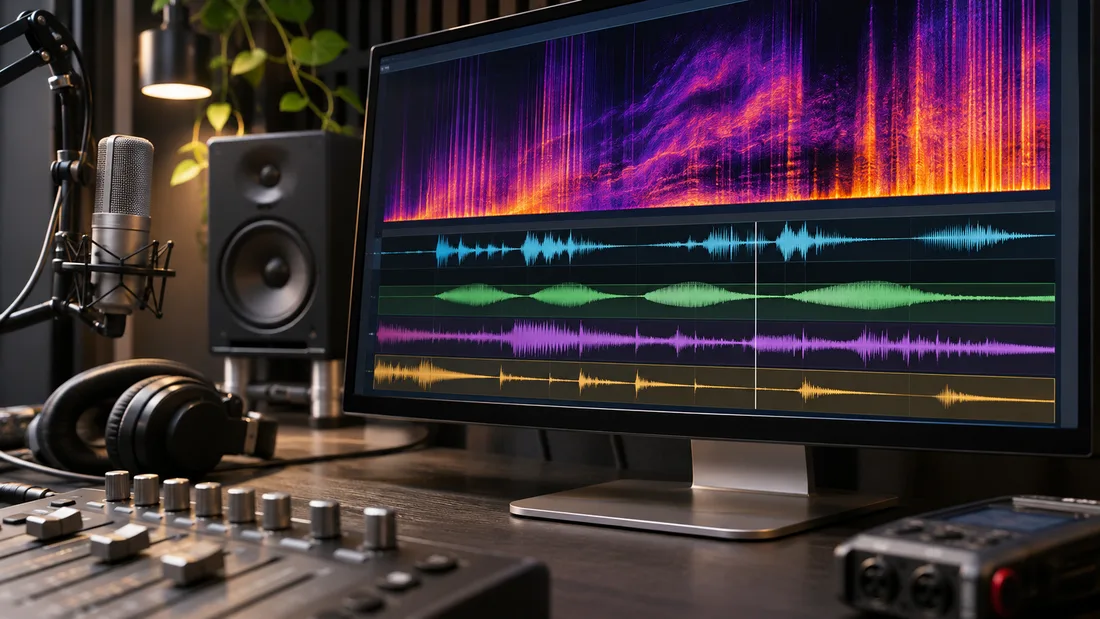
A spectrogram can help identify a narrow tonal feature that competes with music or a short unwanted component that interrupts the sound. Use localized spectral editing or suitable equalization when the problem can be isolated. Dynamics processing may be useful if a particular event must convey consistent energy across several presentations. However, forcing a natural decline to remain uniformly loud can make a convincing sound artificial. Aim to control the relationship between the designed effect and the rest of the arrangement rather than trying to maximize every individual sound.
Watch for unintended content and technical faults
Some generated recordings may contain ambiguous details that were not part of the intended description. A supposed atmosphere can appear to contain distant speech, or a mechanical sound may unexpectedly resemble an instrument. Listen for material that could create a distracting or misleading impression. This is particularly important for journalism, documentary work and reconstructions where listeners may reasonably interpret a familiar sound as evidence of an actual event. A generated ambience should not be presented as original field evidence.
Technical inspection is necessary too. Examine the file for clipping, unusual stereo behavior, awkward changes in the background and unexpected endpoints. A brief quiet interval might contain a residual warbling texture that only becomes conspicuous when boosted during a mix. A wide candidate can lose important information when reduced to mono. Test these characteristics under conditions resembling the final production where appropriate. They are properties of the delivered audio and should not be inferred merely from a generator's description of its capabilities.
Consider provenance and rights early
Generated audio belongs in the same production records as recordings and licensed effects. The applicable terms may depend on the generation service, its licensing arrangement and the intended use of the material. Examine the actual conditions before supplying effects to a client or distributing an isolated library. The fact that a sound was generated rather than recorded does not resolve every question concerning the material's use. Avoid requesting imitation of identifiable performers or sound recordings merely because a tool permits descriptive input.
A simple project manifest can state which source components were recorded, purchased, synthesized or generated. This distinction helps an editor respond if a client has specific requirements about generated material, and it allows individual elements to be replaced without reconstructing the entire sound. Maintain separate versions of important components before mixing them together. Such records also make it easier for another sound designer to understand why an unusual texture sounds the way it does.
Use generators for their appropriate place in production
Generative audio can help create possibilities at an exploratory stage, particularly where the intended sound does not have an obvious physical recording source. Conventional microphone recording remains valuable when a specific object, location or performance needs to be captured faithfully. A synthesizer offers systematic control over pitch, timing and repeatability. Sound libraries supply known recordings whose properties can be auditioned directly. Each approach contributes something different to the design.
The effective test of a generated sound is whether it functions in the completed production. A good result may contain only a small part of one generated candidate combined with several carefully recorded elements. Another effect might work after a simple trim and a change of level. Generating material does not remove the need for judgment about perspective, structure, dramatic timing and the relationship between sound and story. Those decisions remain the substance of sound design.