A recording of an interview made in a crowded restaurant can contain exactly the words an editor needs and almost none of the clarity a listener expects. Cut the low frequencies and the air conditioner recedes; cut the high frequencies and the person speaking begins to sound as though they are behind a curtain. It is a familiar problem because interference is not restricted to tidy frequency ranges. Neural restoration approaches such material by learning the difference between common patterns of sound, rather than asking the editor to draw a boundary that always separates wanted from unwanted energy.
This was an important direction in audio research by the late 2010s. For decades, noise reduction programs had estimated interference from a piece of audio containing only noise. That remains useful, particularly for tape hiss and a steady electrical hum. Neural systems expanded the range of material that could be treated, while introducing a different set of failure modes. The practical question is still the same: how much of the original performance survived the recording?
Noise is a relationship, not a frequency
Defining noise is easy when a microphone captures a narrator speaking alone in a room with a fan. The voice is intentional; the fan is not. The distinction becomes less obvious when a guitarist records an acoustic instrument while tapping their foot. A machine that removes impulsive sounds might erase the tap even though it contributes to the rhythm. In a concert recording, audience reactions can be part of the event itself. An algorithm has no independent knowledge of these intentions.
Traditional spectral subtraction compares incoming audio with an estimate of the noise floor, often using a short-time Fourier transform. The result is a succession of frequency-domain frames, each representing a short interval. Bins with more energy than expected may be preserved; those consistent with the noise estimate can be attenuated. An aggressive setting can create little tones and rapidly changing textures sometimes described as musical noise. Reducing the amount of subtraction can be a better choice than attempting to eliminate every audible trace of interference.
A learned denoiser similarly works with time, frequency or raw waveform information, but its estimates are influenced by examples used during development. The system might recognize a pattern of harmonic energy typical of voiced speech, transient consonants or background ventilation. Learned masks can vary more intelligently across time than an estimate derived from a stationary noise profile. However, unusual voices, unfamiliar environments and audio that differs from the training material can still expose the limits of the method.
The first decision is whether speech is intelligible
Before adding any restoration plug-in, listen to the recording at a comfortable level without processing. Mark passages where individual words are unmistakable, those that require several listens and any stretches where meaning is genuinely absent. The three grades deserve different treatment. An already comprehensible sentence may need nothing more than a little attenuation of the background. A difficult sentence might benefit from a targeted process. A sentence in which the microphone was disconnected cannot be recovered from that channel by filtering.
The same assessment applies to clipping. Digital clipping truncates peaks above the available range, removing information about the original waveform. A repair tool can estimate plausible peak shapes from neighboring samples. The result may look smoother on screen and sound less abrasive, but the process cannot reconstruct the exact lost samples with certainty. Distinguish improved intelligibility from recovered evidence, particularly when editing documentation of a real event.
Keep the untouched file and work on a copy at its native sampling rate. If a recorder offers multiple channels, inspect each before committing to a repair. A quiet backup recording with intact peaks can outperform extensive treatment of a damaged main track. Align the channels using a common transient, check the phase relationship and choose one clean source where appropriate. The availability of multiple takes or independent recordings changes the problem entirely.
Speech enhancement and the disappearance of room sound
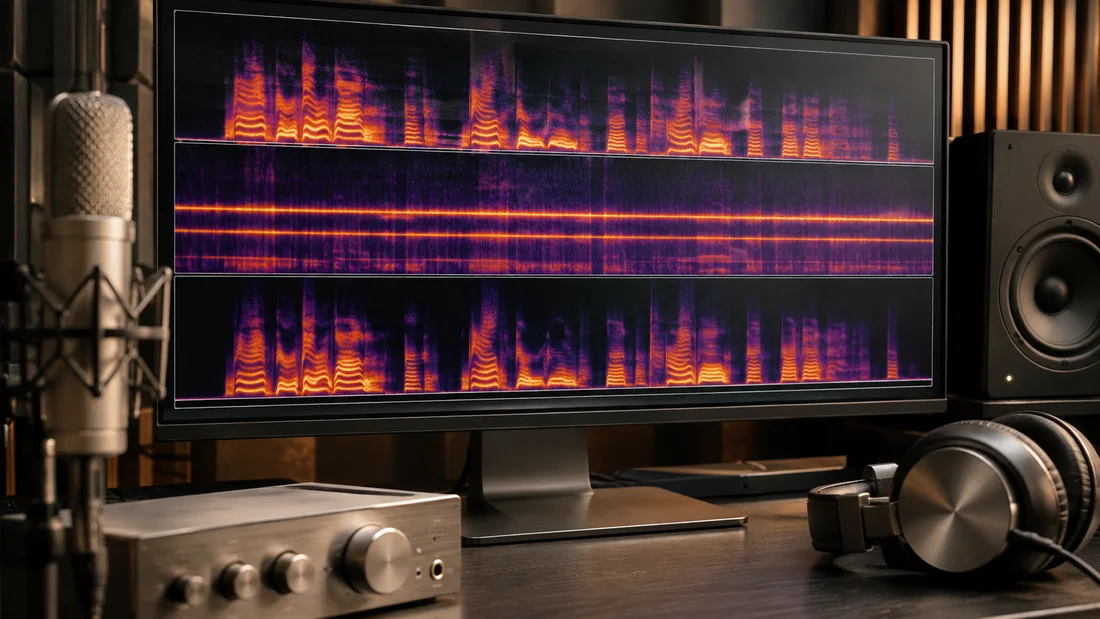
Room reverberation presents a harder case than the sound of a fan. Reflections are copies of the original signal, delayed and filtered by nearby surfaces. They overlap later syllables, sometimes by hundreds of milliseconds, so they cannot simply be identified as an unrelated sound. De-reverberation tools try to distinguish the direct voice from this changing reflection field. With moderate processing, a distant microphone can become easier to understand. Pushing the effect too far may make the ends of words flutter or acquire unnatural gaps.
An appropriate amount depends on the delivery. A dry voice placed under music may tolerate fairly substantial change because the mix provides context. For an intimate solo interview, artifacts and transitions are more exposed. The restoration must be judged in the actual program, not by soloing the processed track indefinitely. Make a level-matched comparison of the original and restored audio; a louder version often seems clearer merely because it is louder.
Listen specifically to low-level consonants, breaths, word endings and changes in distance from the microphone. Some systems have difficulty with a sentence beginning after a pause. Others reduce an airy vowel or a faint laugh as if it were noise. If the voice seems thinner or less recognizable, reduce the intensity, switch modes if available or use the processor only within the problematic region. A gentle high-pass filter may remove handling noise without affecting the rest of the spectrum.
A restoration session that stays reversible
Use a new track or a clearly named file for each distinct treatment, preserving the relationship to the original timecode. An editor may need to revisit a questionable passage weeks later. Saving several intermediate stages can help identify the one process responsible for a newly audible artifact. When offline rendering, keep the same start and end positions unless a deliberate edit is required. This makes switching between original and processed versions much easier.
Consider the order of operations. Repair obvious clipping before applying processes that interpret the distorted waveform as normal audio. Remove a narrow electrical hum with a targeted filter where practical; a broadband neural processor may not be necessary. A simple edit with sufficiently long crossfades can fix isolated clicks. If substantial denoising is required, work before adding strong compression. Heavy compression raises low-level residual noise and may complicate the denoiser's estimate. Equalization after the main repair is often sufficient to restore an appropriate tonal balance.
For speech separated by long pauses, room tone can be preserved on a separate track and blended beneath edits. Perfect digital silence between phrases sometimes sounds less natural than the original room. Avoid using an unrelated ambience to suggest that the speaker was in a different environment. It should simply prevent the noise floor from jumping unnaturally with each cut.
How to compare several processing strengths
Choose a segment containing the hardest representative problem, not the cleanest sentence in the file. Create light, medium and strong versions using the same starting material. Match the output levels and listen without watching the controls. In a complicated repair, one version may offer the best intelligibility while another sounds more natural. Try a mixture of processing strengths within the timeline or use an automated amount control if the program supports it.
Check these choices both on headphones and on a modest speaker. Headphones make many fine artifacts easier to detect; a small speaker can reveal whether the words still carry when the lowest frequencies are absent. Speech editors should also confirm that the processed output retains meaning. Ask another listener to transcribe an ambiguous phrase without being told what it is supposed to say. A restoration tool can create phoneme-like textures that invite expectation to fill gaps, so an independent check is valuable.
Finally, retain records of substantial repair decisions. For a documentary or an archive, an explanatory note about denoising and reconstructed peaks is important. Do not describe a generated estimate as a direct extraction of missing original sound. If words cannot be recovered with confidence, acknowledge the gap. A successful restoration brings the surviving performance forward while leaving the uncertainties visible, rather than concealing them behind an impressively quiet waveform.