A producer receives a stereo recording of a band from a performance years ago. The multitrack session has been lost. A remix would benefit from an isolated vocal and a quieter bass instrument, but the two-channel file contains every instrument mixed together. Until relatively recently the standard responses were to look for the original master, work around the problems with equalization or record the parts again. Learned source separation offers another possibility, though the recovered tracks need to be understood for what they are: estimates of the sources that may have contributed to the available signal.
The mathematics explains why this problem is different from reopening a multitrack project. If a mixed signal contains several unknown signals summed together, there are many possible combinations that produce the same result. Separation uses assumptions about the structure of music to estimate a plausible combination. It can be remarkably useful, but those assumptions set limits on which parts of a particular recording can be isolated convincingly.
What happens when tracks are mixed
In a simplified linear model, the left channel of a song is a weighted sum of several source signals and the right channel is another weighted sum. Panning changes the relative coefficients in the two channels. In a sparse arrangement, differences in position make some separation possible. A vocal placed equally in both channels may be reduced by subtracting one channel from the other. Unfortunately, another centered source such as a kick drum may disappear at the same time.
Real music productions are less straightforward than this model. Reverb spreads a voice into the stereo field, and the reflections overlap the other instruments. Dynamic processing alters the relationship between peaks and averages. A limiter may react to the combined signal rather than to individual tracks. Distortion can introduce frequencies that were present in neither input alone. Even a technically perfect estimate of a component of the mastered file would not necessarily match the track before those effects.
This is why separation products usually talk about broad groups such as vocals, drums, bass and other instruments. Each group represents a working assumption about the kind of material to be found in the mix. A choir containing many overlapping voices is not automatically separated into individual singers. Nor will a guitar category routinely distinguish left and right double-tracked rhythm parts, each occupying a similar frequency range.
How learned separation became practical
Traditional methods for separating music have used harmonic structures, repeated patterns and spatial relationships in stereo recordings. A voice and a pitched instrument tend to show clear harmonic patterns in a spectrogram, while some percussion produces shorter vertical bursts of energy. Algorithms can exploit these differences, but complex arrangements quickly violate the simple distinctions.
By the end of the 2010s, deep learning systems had shown the value of training with examples of separated musical sources. During development, recorded stems can be combined into mixtures so that a network receives the mix and learns to predict the component parts. Some methods estimate how to distribute energy among sources in a time-frequency representation. Others operate more directly on waveforms or combine several representations. The network is guided by the types of source material and production techniques it encounters during training.
This approach makes separation possible even when an instrument is not isolated by panning and equalization. A model recognizing typical characteristics of singing can preserve a vocal at frequencies shared with other instruments. Difficult cases remain. A distorted lead guitar may resemble a rough vocal; cymbal noise and sibilants share broad spectral properties. The output of a model often contains remnants of other sources and small changes to the source it is intended to preserve.
Choosing and checking a source recording
Use the best available stereo file rather than a low-bitrate copy obtained from an unrelated distribution process. Lossy encoding alters fine spectral detail, and repeated transcoding can introduce further artifacts. If a lossless source is available, begin there. Preserve the original, including its sample rate and channel layout, before converting it for the separator.
Choose a segment containing the problematic material and try the separation before processing the whole recording. A quiet intro with an isolated voice may yield a much cleaner result than a loud chorus containing harmonies and cymbals. If the desired result is a vocal stem, inspect passages where the singer shares frequencies with an exposed solo instrument. For bass work, listen around drum transients and lower notes of piano and guitar.
The results should be compared in musical context. Some artifacts are obvious when a stem plays alone but become nearly inaudible when new instrumentation is added. Conversely, an apparently convincing isolated stem may have lost the short transients that made it work rhythmically within the original track. Alternate between the original mix, the separated element and a prospective new arrangement. Select a separation method with the intended task in mind.
Building a reconstruction without accidental level changes
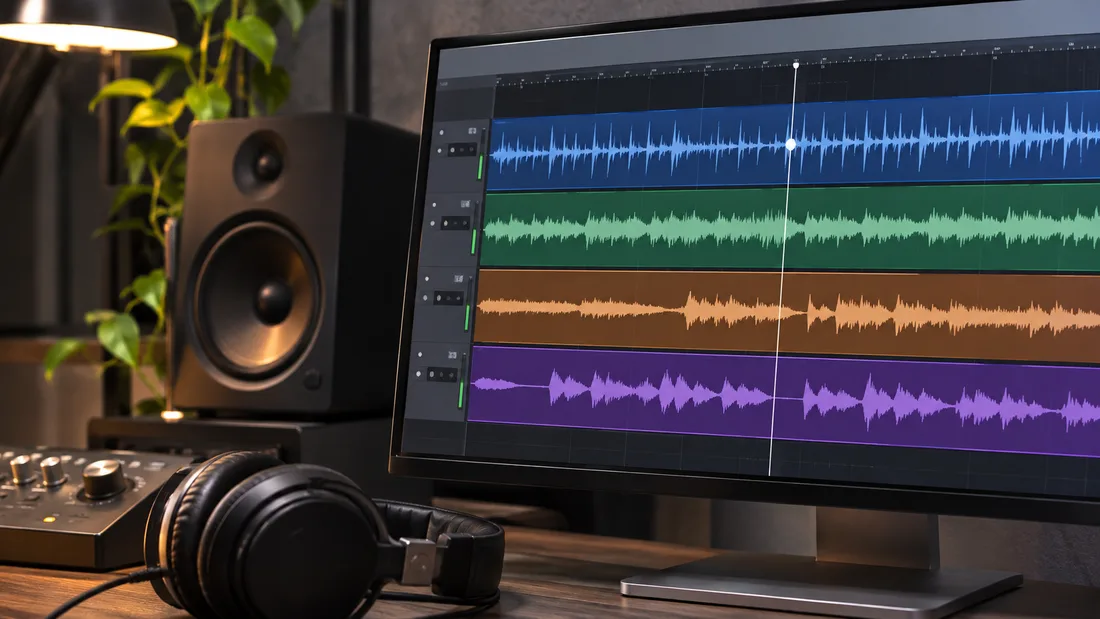
Place exported stems at the same start point in a session whose sample rate is appropriate for the source. Ensure the program has not applied automatic normalization or imported the files with different gain settings. Some separators produce components designed to sum close to the input mix; others allow the reconstructed mixture to differ. The program's output does not establish which relationship applies, so perform a direct comparison.
Listen to the sum of the stems, matched to the original in perceived level. Check whether there are audible missing textures, changes to transients or irregular shifts in stereo width. If the export is expected to reconstruct the source sample for sample, a polarity inversion test can reveal residual differences between the summed estimates and the original. A nonzero difference is not necessarily a sign of a defective program; it may reflect the way the estimates are generated or reconstructed.
Make new gain and processing decisions after establishing that baseline. Lowering a separated drum stem can also lower pieces of an unrelated source that leaked into it. A narrow boost applied to the estimated vocal may emphasize residual cymbal noise as well as the singer's consonants. Use restrained settings at first and pay attention to regions where the separation changes quality.
Why editing the arrangement can work better than aggressive repair
When the goal is to create a backing track, a relatively clean estimate of the accompaniment may be more important than a perfect vocal removal throughout the song. A short leftover phrase might be concealed by a new instrumental part or a sensible edit, provided the use is authorized. An unusually exposed introduction may require a manual edit instead of a stronger global separation setting.
For archival repair, the production objective is different. A separated voice might allow a listener to understand text that was formerly masked, but processing can modify the timbre and remove some syllables. Preserve the full recording and the extracted version together. If the recording is used as evidence of a statement, confirm the words against the source whenever possible. Avoid representing an estimate made by a generative or learned processor as an untouched original track.
Music practice is another productive application. A bassist can reduce the bass in an authorized recording and play along with the remaining material, while a singer may want the reverse. In either case the imperfect residue is unlikely to matter if the rhythmic information remains clear. For a commercially released remix or a sampling project, rights in the original recording and composition remain relevant even if a program has produced separate files. Separation is an audio operation, not a transfer of permission.
When the original mix is still the best source
Do not overlook simpler approaches. If the desired change is a small reduction of excessive bass in the complete song, conventional equalization or multiband dynamics may preserve the remainder of the mix more accurately than splitting and recombining it. A vocal edit confined to one brief phrase may be possible using a nearby silent region or a replacement take. The more intact the original material, the fewer assumptions the processor needs to make.
Keep the separated stems alongside the stereo file, record the process used and retain notes about problematic passages. When possible, seek the original tracks or obtain an export from the engineer. A two-channel mix contains valuable musical information, but it does not contain a convenient hidden copy of every microphone. Successful source separation makes special use of the surviving information; it does not erase that fundamental distinction.