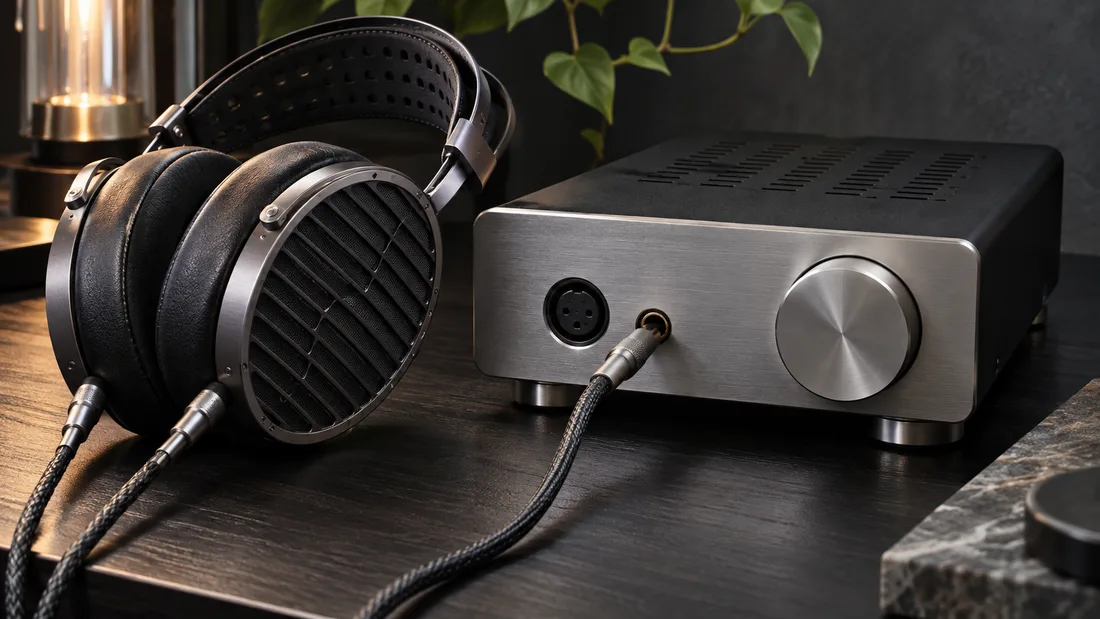
The volume control on a headphone amplifier conceals two distinct electrical demands. One is the voltage required to make the transducer produce a particular sound pressure. The other is its current at that voltage. The headphones determine the relationship between them. An amplifier described only as powerful has not told a buyer whether it can drive a high-impedance dynamic headphone cleanly or whether it has sufficiently low noise for a sensitive earphone.
Read sensitivity before drawing conclusions about impedance
Manufacturers usually publish a nominal impedance for passive wired headphones. It is the opposition the headphones present to alternating current under specified conditions and is measured in ohms. Dynamic headphone impedance can vary with frequency; some planar magnetic designs exhibit a relatively flat impedance curve through much of the operating band. Nominal impedance is a useful starting point, but it is not a direct indicator of loudness.
Sensitivity describes the sound pressure generated under a particular electrical input condition. It may be given as decibels sound pressure level for a milliwatt of input power or as decibels for a specified voltage. Those two unit conventions cannot be compared directly without accounting for impedance. A headphone rated at 100 dB SPL per milliwatt is not equivalent to another rated at 100 dB SPL per volt, regardless of whether the specifications both carry the same number.
High impedance can require a substantial voltage to reach a specified electrical power; lower impedance at that same voltage draws more current. Neither arrangement inherently signifies a sophisticated or inefficient headphone. Efficient portable designs are often suitable for devices with limited output voltage. Demanding models can use a separate amplifier with adequate voltage capability, current capability or both.
Estimate power using sensible assumptions
Consider a hypothetical 32-ohm headphone rated at 96 dB SPL for one milliwatt. Raising the electrical power ten times corresponds to a theoretical increase of 10 dB in sound pressure when the transducer behaves linearly. Ten milliwatts would therefore correspond to approximately 106 dB SPL under the same measurement conditions. The voltage derived from the relation power equals voltage squared divided by resistance is about 0.57 volts RMS.
Take a hypothetical 300-ohm headphone with the same sensitivity per milliwatt. Reaching that electrical power requires approximately 1.73 volts RMS. Current is lower than in the 32-ohm example. If the amplifier can achieve the necessary voltage into the respective impedance without significant distortion, both theoretical requirements can be met. The amplifiers do not need to produce the same current, voltage or peak headline power to accomplish the task for the two loads.
These illustrative figures are not listening level recommendations. Headphone sensitivity measurement techniques, the shape of the test fixture, different frequency responses and real music level all complicate a direct mapping to exposure at a person's ear. Hearing protection requires a cautious, moderate level and attention to total exposure time. Additional clean peak headroom should not be confused with a safe sustained listening level.
How to interpret an output rating
A headphone amplifier's specification might state output power into 32 ohms and a second figure for 300 ohms. That pairing is useful because it reveals something about the available voltage and current across different loads. But the conditions matter. A maximum figure without an accompanying distortion threshold, measurement frequency or number of channels driven does not communicate all the constraints.
Many compact devices are limited by their supply voltage. An amplifier may drive low-impedance headphones to a suitable volume but clip on peaks with a relatively voltage-hungry headphone. Another amplifier might achieve sufficient open-circuit voltage yet reach a current limit with a demanding low-impedance load. In either case it is sensible to look for output data at an impedance similar to that of the actual headphones.
Do not equate the largest prospective number with the best performance. A headphone power output of several watts may be useful for a demanding load, but an amplifier with substantially less available power may still operate far below its limits in a particular system. For highly sensitive earphones, residual output noise, gain choices and channel tracking at very low volume control positions may be more consequential.
Output impedance and a changing bass response
Amplifier output impedance forms a voltage divider with headphone impedance. If the latter varies substantially with frequency, the delivered voltage may also vary. A relatively high output impedance can accentuate frequencies at which headphone impedance rises, altering the effective response compared with a source whose impedance is close to zero. The magnitude and shape of the effect depend upon the impedance curve rather than nominal impedance alone.
A low-output-impedance amplifier gives a predictable basis for evaluating many headphones according to their intended tuning. Some historical amplifier headphone sockets and specialised designs use higher source impedances. They may work well with some headphones and poorly with others. The manufacturer's recommendations deserve attention for carefully matched products.
A change in bass that accompanies a change of amplifier might result from this interaction, rather than a uniquely detailed presentation created by expensive internal components. Equally, a voltage-limited source may distort on loud peaks and thereby change the sound. Identifying the mechanism gives the listener a chance to solve a genuine electrical mismatch instead of describing the experience exclusively in metaphor.
Gain is not the same as power
An amplifier gain setting determines how much its output voltage rises relative to the input voltage. A high gain setting does not necessarily change the maximum clean voltage or usable power that the circuitry and supply can deliver. It may simply allow that voltage to be reached with a smaller input signal or a lower volume control position. A source delivering a large line-level voltage might need very little additional amplification.
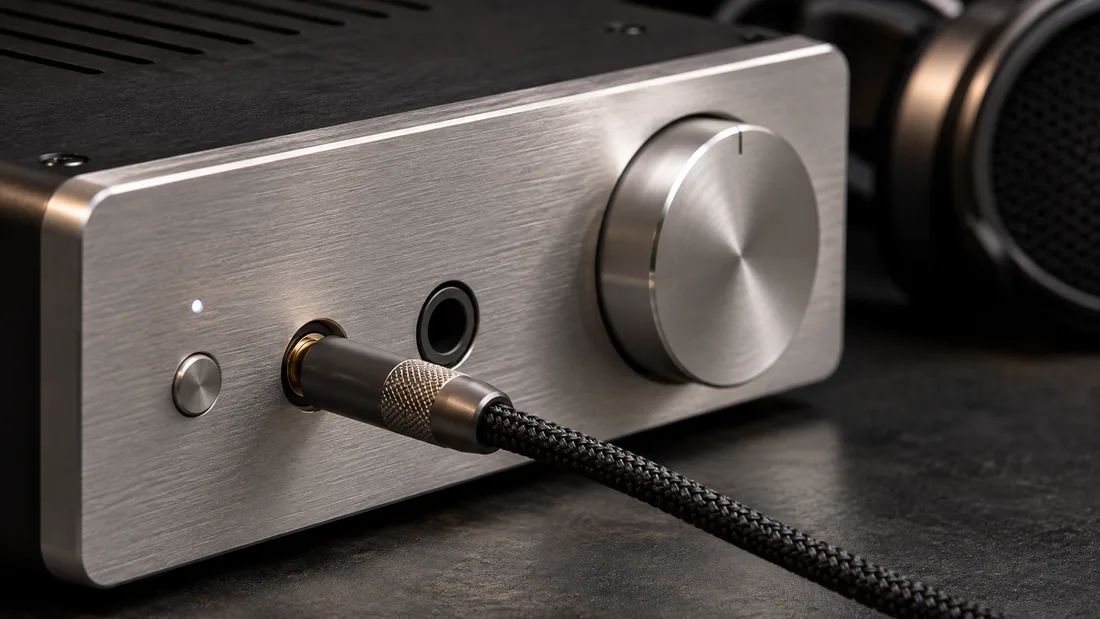
Start with a low gain setting when available. This tends to provide a more convenient adjustment range with sensitive headphones, and in some circuit designs it reduces the audible consequences of upstream noise. Select higher gain only if the source and load require more usable output. Muting the amplifier or turning the volume down before changing gain avoids the possibility of an unexpectedly loud result.
Balanced headphone connections are sometimes promoted as more powerful. A differential output may deliver greater voltage for a given supply architecture, but its use is not a universal guarantee of better noise or distortion performance. Never adapt a differential headphone output to a shared-ground connection unless the manufacturer explicitly permits the arrangement. Some output stages cannot tolerate the two driven negative terminals being joined.
Separate DAC and amplifier decisions
A convenient desktop device may combine a digital-to-analogue converter with a headphone output and a line output for powered loudspeakers. That combination can solve several connectivity and volume control requirements. It can also be useful to have an analogue headphone amplifier that accepts the existing converter or phono stage directly, especially when switching multiple analogue sources.
Make sure a connector actually provides the type of output its appearance suggests. A headphone socket can use the same physical form as an output serving a different standard or purpose. Likewise, a line output is not always variable with the front panel volume control. Check whether output routing, gain and muting behaviour work with the intended daily routine before installing any device beside active monitors.
A buying checklist that excludes needless duplication
Write down the exact headphone model, nominal impedance and sensitivity units. Look for an amplifier rating at a similar load, then compare the intended listening demands with the available clean voltage and power. Check gain modes, residual noise, output impedance and source connections. If the existing device already reaches a comfortable volume without audible noise or distress and has enough peak margin, a new amplifier is unlikely to resolve a meaningful limitation. A different tuning, better fit or an appropriate equaliser may accomplish more. A well-chosen amplifier disappears as an operational problem and allows the headphones to perform as designed.