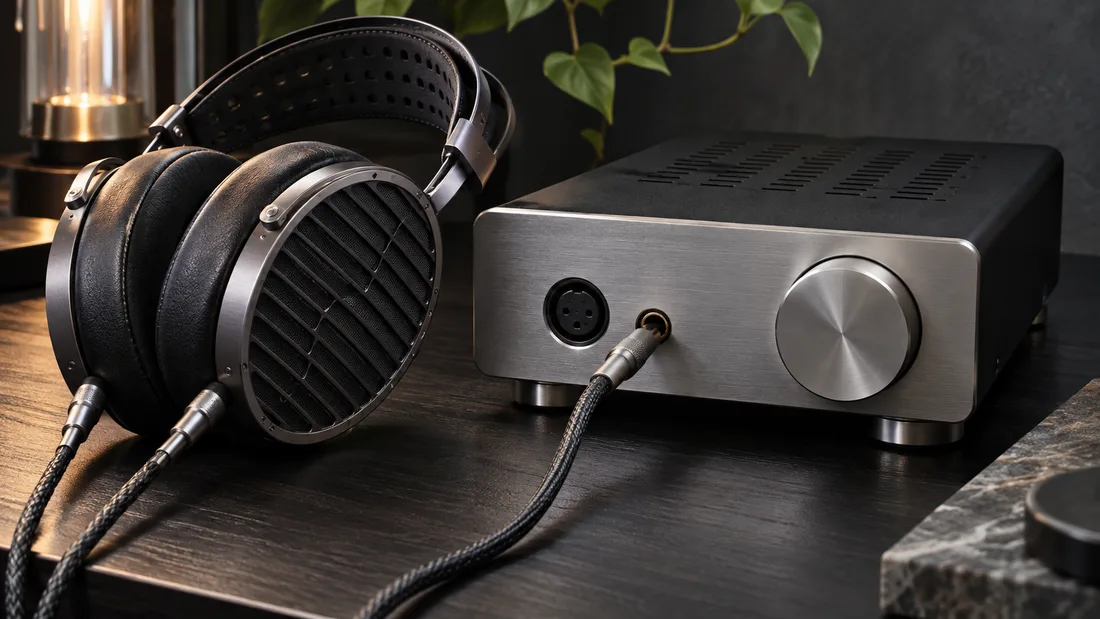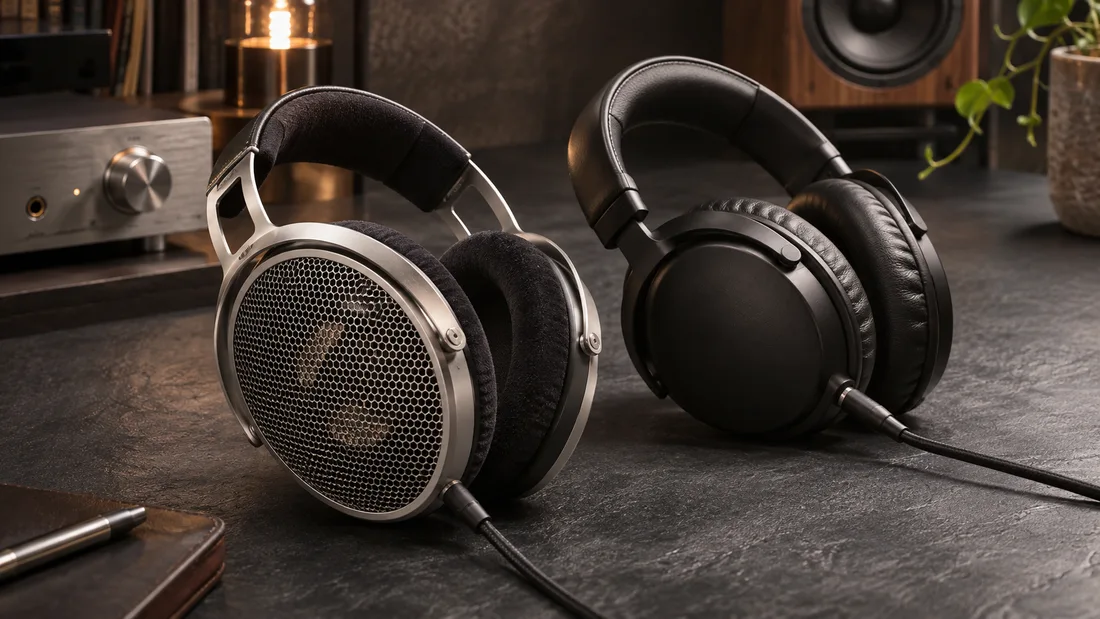
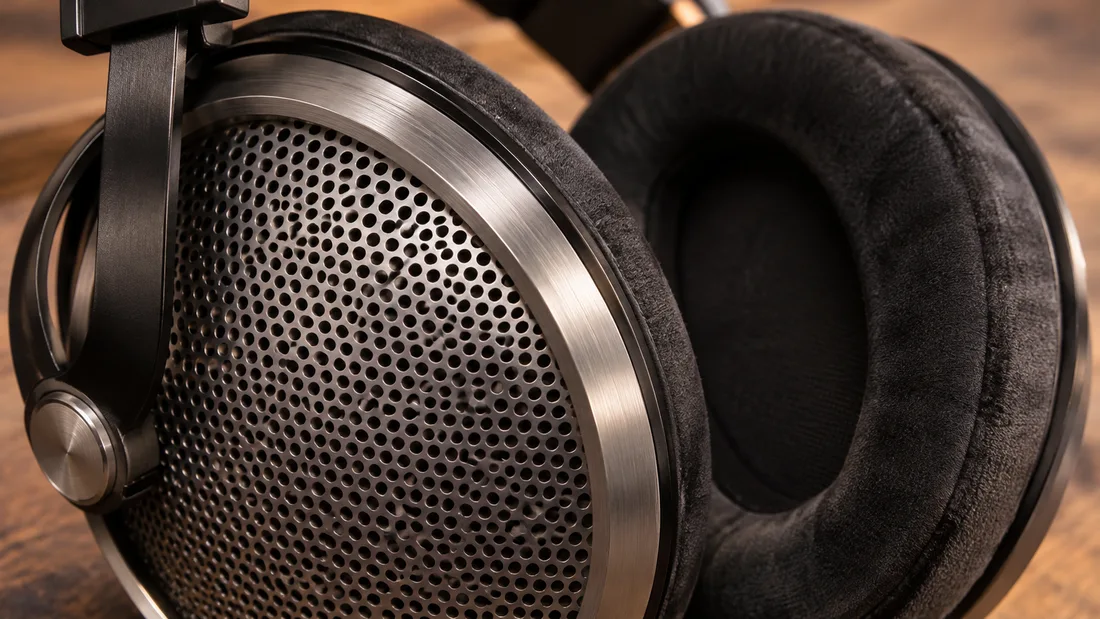
Remove the headphones from their stand and look behind the earcup. A solid outer shell usually indicates a closed-back design. A grille or a perforated section suggests that at least some of the acoustic energy from the rear of the driver can enter the surrounding air. The difference is immediately visible; the consequences for listening are more complicated. Either type can sound superb, and neither enclosure tells us how neutrally a particular set of headphones has been tuned.
What an enclosure changes
A moving transducer sends sound from both sides of its diaphragm. In an open headphone, the back of the driver communicates with the external environment through a deliberately arranged grille, acoustic damping or other open structure. A closed shell encloses much of that rear radiation. Its shape and internal materials, along with the position of the driver and cushions, influence reflected energy and the pressure experienced by the diaphragm.
The cabinet of a closed loudspeaker plays a substantial role in shaping its sound. There is an analogous engineering problem inside a closed headphone, even though its listening environment is very different. A designer may add damping material, create specific acoustic paths or provide carefully controlled vents so that the driver operates within a suitable range. The compact cavity presents a difficult environment in which to manage energy at a wide range of frequencies.
Open headphones still require acoustic design. A large exposed surface at the rear does not eliminate resonances in the earcup, driver mounting, cushioning or the space between the driver and ear. Some open designs incorporate elaborate structures to guide the airflow and alter their frequency response. Whether a grille is made of metal or plastic does not by itself answer any serious question about the sound.
Isolation is the practical dividing line
One of the compelling reasons for buying a closed pair is to reduce the sound reaching other people and the amount of ambient noise disturbing the listener. The qualification is important. Headphones form an imperfect seal around the ear, and their isolation varies from one frequency to another. They block some high-frequency noise fairly well while leaving the deep rumble of a bus audible.
That rumble matters because it masks music even when it does not appear unreasonably loud. Raising the playback level to compensate may expose the ears to excessive sound. Active noise cancellation, where offered, can bring substantial benefits at lower frequencies in predictable noise. It is not the same thing as the passive isolation supplied by the shell and pads.
Open models offer essentially no useful acoustic privacy. Someone nearby can hear the programme and the user hears a keyboard, a conversation or an air conditioner almost unobstructed. In a solo room this may be inconsequential. In an open-plan office, train or library, it quickly becomes the principal consideration. Even if an open headphone wins a quiet-room comparison, the closed alternative may convey more detail in the actual place where it will be used.
Why fit belongs in every listening comparison
Over-ear headphones use cushions to make an acoustic interface around the edge of the ear. Moving one earcup a few millimetres, wearing glasses with a thick temple or having a strand of hair break the seal can modify the bass response. This happens especially with designs that rely substantially on a well-sealed listening chamber. The cushions also set the distance between driver and ear, affecting upper-midrange and treble behaviour.
Try headphones with the glasses, hairstyle or accessories normally worn while listening. Adjust the headband carefully and check whether the opening comfortably surrounds the ear. There is little point in seeing what a careful ten-minute audition reveals about texture and imaging if the pair becomes uncomfortable after half an hour. Some people feel uncomfortable with substantial clamping pressure; others dislike the mass resting on the top of the head.
Cushions age as well. Foam gradually compresses, fabric becomes worn and vinyl surfaces can deteriorate. A replacement may recreate the intended response if it matches the original design. An aftermarket pad that modifies the aperture, material or spacing is an acoustic modification as much as a comfort accessory.
Soundstage beyond the enclosure
Listeners frequently describe an open headphone as having an airy impression of space. There are sensible acoustic reasons why particular open designs might make a less confined impression, but the result cannot be guaranteed from enclosure type. Some open models put musicians in an intimate, close arrangement; some closed models convey a wide stereo field.
Headphone listening differs from loudspeaker listening because the left channel mainly reaches the left ear and the right channel mainly reaches the right ear. The auditory system normally uses acoustic information that differs at each ear when identifying a source in a room. Conventional stereo records do not necessarily reproduce that information when the channels are separated by headphones. The listener may perceive events across the inside of the head instead of a stage sitting physically in front.
Measurements of frequency response, individual ear shape, the way the driver's output reaches the pinna and details of the programme all influence the impression of externalisation. Headphones cannot remove that complexity simply by leaving the rear of the earcup open. A phase or spatial processing feature in the source may also change the outcome.
Using headphones during music production
Closed headphones are the established practical choice when capturing a vocal take beside a sensitive microphone. The performer requires a timing reference, guide vocals or backing accompaniment, but too much acoustic leakage from the headset contaminates the recording. A reasonably well-sealing pair allows adequate monitoring volume and reduces the chance that the click track appears in otherwise quiet sections of the take.
Open headphones can be useful when an engineer is listening without an open microphone in the room. They are often comfortable for lengthy editing sessions, and the absence of a sealed exterior may make the ear feel less hot. A comparison with loudspeakers remains valuable. A decision about stereo separation or low-frequency balance made exclusively with headphones may translate differently to a stereo system in a room. Conversely, headphones make it easy to identify minor edits, mechanical noises or short discontinuities that might go unnoticed with speakers.
The choice therefore changes within one production. A recording room needs enough durable closed pairs for performers; the control position may use a comfortable open pair for supplementary monitoring. It is a division of labour rather than two degrees of professional quality.
Decide with a repeatable audition
Choose a quiet setting for the initial comparison, adjust each model independently, and set similar perceived levels. Use speech, a natural acoustic performance, a recording with deep bass, and a dense amplified arrangement. Do not substitute a test tone for the fit check. Move the head and see whether the balance changes. Listen for the amount of outside noise that remains audible and ask someone to report the degree of leakage at a reasonable volume.
If the pair is intended for a journey, repeat the comparison with plausible background noise. For recording, place a microphone near the listening position with playback off and on to see how much signal escapes. There is no need to rely on an abstract description of leakage when a straightforward check can establish the practical consequence.
Impedance and sensitivity need consideration once the preferred models have been identified. An open pair may be easy to drive and a closed pair demanding, or the other way around. Verify that the planned source can supply enough clean voltage or current without operating constantly at its limit. If acoustic isolation, fit and tuning agree with the listener's circumstances, detailed comparisons of headphone amplification become much more meaningful.