An acoustic guitar produces a rich assortment of individual sounds. A plucked string vibrates over the soundboard, the bridge transfers some of that movement to the body, air resonates inside the instrument, and a guitarist's fingers introduce additional sounds. Hearing this from across a room provides a different impression from listening with an ear near the soundhole. The recording engineer can exploit those differences rather than asking a microphone to reproduce an imagined single correct version of the instrument.
The instrument is already a complex sound source
Before setting out equipment, listen to the guitar while the player performs a passage from the actual piece. The same instrument will produce a surprisingly different sound when it is played with a hard pick, with fingertips or with fingernails. A fingerstyle arrangement may depend on subtle inner voices and comparatively quiet bass notes. Strummed accompaniment may create a broad sweep of sound that has to share space with drums and lead vocals. The recording position should reflect that musical role rather than follow a convention chosen for every acoustic guitar.
Move around the player while they perform. Directly in front of the soundhole, the body and its air resonance can be particularly prominent. A position near the neck may offer more of the finger movement and string sound, while the lower bout can reveal a different body balance. The guitar's sound is directional at higher frequencies, with the exact behavior dependent on its construction. The player's torso and the floor also create reflections. These factors explain why moving a microphone a few centimetres can change how a guitar sits in an arrangement.
A mono recording from the neck-body joint
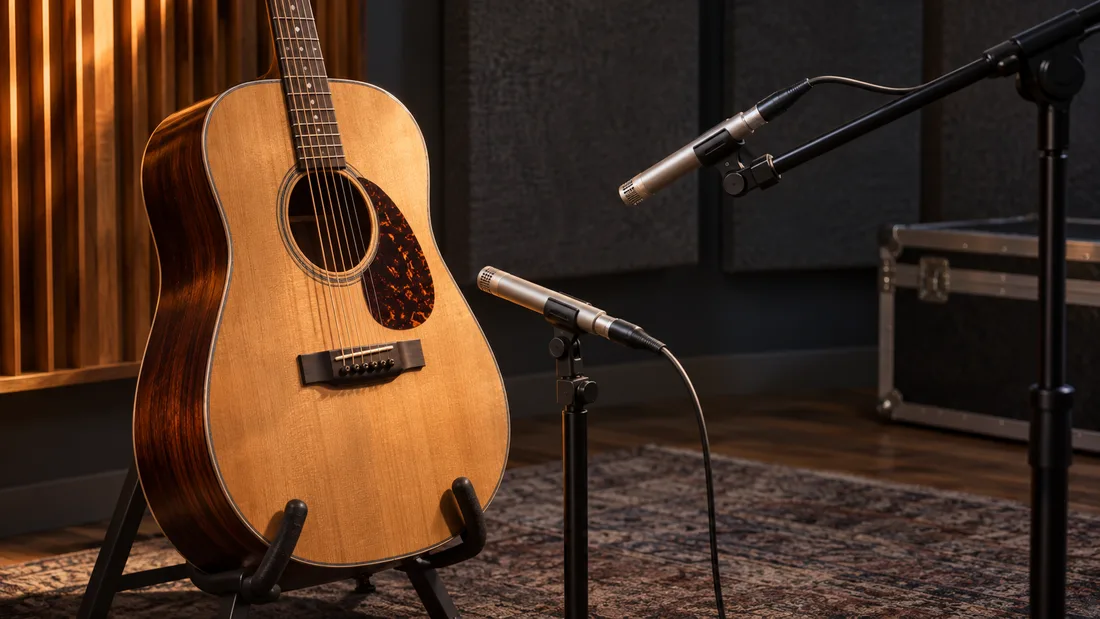
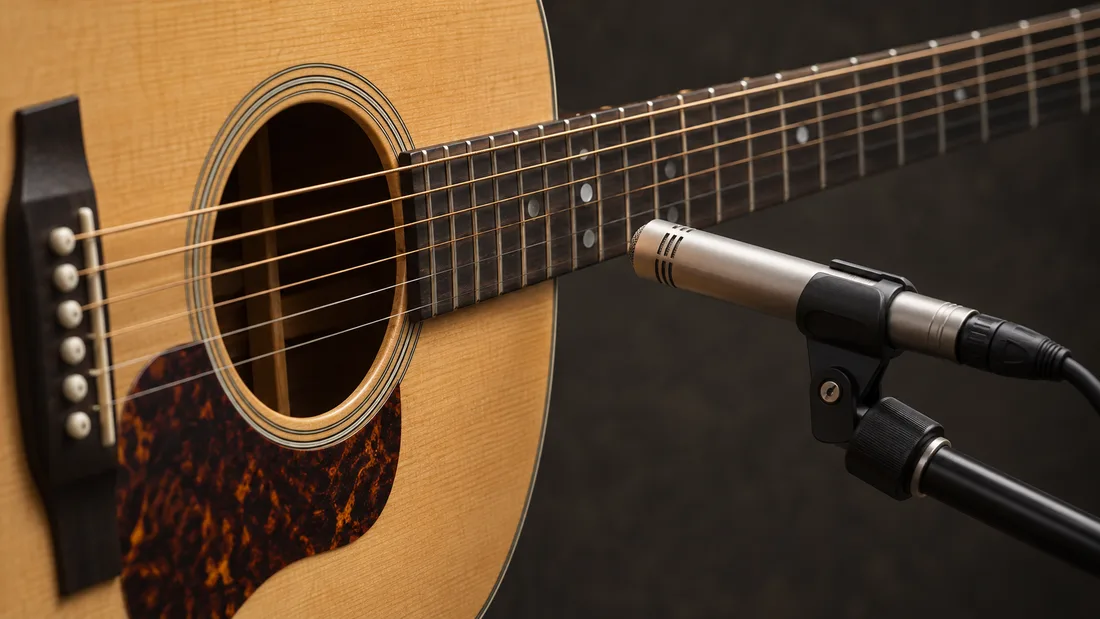
A good first position for many acoustic guitars puts a directional condenser several tens of centimetres away from the area where the neck meets the body. Pointing around the twelfth fret usually captures useful string articulation without directly facing the soundhole. Adjust the angle toward the body for more resonant sound or farther along the neck to emphasize string detail. A small-diaphragm microphone is convenient because its dimensions make placement straightforward and many examples offer well-controlled off-axis behavior. An appropriate large-diaphragm model can also work well.
Finger movements sometimes produce too much scrape or squeak in a close neck position. Repositioning the instrument or microphone usually has fewer side effects than attempting to remove such sounds with a high-frequency filter. A player may also change how their fretting hand meets the strings if the issue has been identified accurately. Avoid giving such instructions on the basis of a solo track without first listening in context. A degree of mechanical sound provides useful information about the physical performance and can contribute to a natural sense of presence.
Check the floor and the placement of other hard surfaces. A close microphone pointing down toward the guitar may receive a floor reflection a short time after the direct signal. Moving the player onto a different part of the room or raising the microphone may produce a less hollow recorded sound. Unlike an equalizer adjustment, a physical change can remove the source of a localized cancellation instead of attempting to compensate for an already recorded interference pattern.
Taking a complementary second perspective
A second microphone can be placed toward the bridge or lower body while the first remains near the neck-body joint. The arrangement offers independent control of a string-focused and a body-focused perspective. However, these are not entirely separate sources. Both microphones hear overlapping components of the entire guitar, with different times of arrival. Blending them produces frequency-dependent interference. Some such interaction is unavoidable and may even be aesthetically useful, but the engineer must know how the signals behave together before committing to a balance.
Record a mono sum while the guitarist plays sustained low notes and a representative chord pattern. If the low end weakens or the upper sound becomes unnaturally hollow when both microphones are brought up, move one of them and repeat. Inverting the polarity on one channel sometimes reveals that the initial combination has a broadband problem, though polarity inversion alone cannot correct all time-of-arrival differences. Keep each track separate so their blend can change later. For a busy arrangement, one microphone may ultimately prove enough despite the availability of two tracks.
Coincident stereo pairs
Using two directional capsules near a common point with axes facing apart captures stereo primarily through left-right level differences. A conventional X-Y pair can provide a stable centre and a useful stereo image without introducing large time differences from widely spaced microphones. Particular holder designs permit small condenser capsules to sit very close together. The important position is the approximate centre of the active capsules, not the crossing of two tubular microphone housings.
The pair's distance from the guitar controls how its separate radiating areas appear between the speakers. Placed very close with a fairly open included angle, the two sides might emphasize different parts of the instrument dramatically. Placed farther away, the guitar can form a more compact image and the surrounding room becomes more obvious. Such decisions should be made while monitoring with reasonable stereo speakers or a trusted pair of headphones, not while looking only at the signal meters.
Another method uses a forward-facing centre microphone and a lateral figure-eight microphone in a mid-side configuration. During mixing, the contribution of the side signal to the resulting left and right channels can be adjusted. If a project calls for both a wide solo performance and a narrow version beneath narration, that flexibility can be attractive. Check all connections and confirm that the decoded stereo signal collapses appropriately when summed to mono.
Spaced pairs demand careful listening
A pair of microphones separated physically can produce both level and time differences between channels, offering another approach to stereo scale. In a sufficiently lively room, it may convey an impression of the instrument's surrounding space. When placed at different distances, those tracks may combine unpredictably on a single loudspeaker. Stereo headphone listening alone can conceal this problem because the two channels are acoustically isolated from one another. Check the mono sum and move the microphones as necessary. If the guitarist moves a great deal while performing, ensure that the chosen pair remains reasonably consistent throughout the piece.
For a solo recording, it can be valuable to supplement a more direct pair with a microphone farther from the player to record the room itself. Resist the temptation to place an extra microphone wherever there is a spare stand. At a useful distance, the microphone should convey a distinct and attractive perspective. A thin reflection-heavy sound may become unpleasant when compressed or boosted in the mix. In a room that lacks appealing acoustics, a restrained close recording followed by carefully chosen artificial ambience is a perfectly reasonable option.
Finish the setup with the guitarist in mind
A stand must not block the fretting hand or force an unusual playing posture. Secure microphones before the performance and route cables away from the musician's feet. A stereo array can become particularly cumbersome if placed too close. Ask the guitarist to perform at the quietest and loudest expected levels, leaving sufficient headroom at the recorder. When recording separately from other instruments, a moderate monitor balance helps the player judge rhythm without introducing excessive headphone spill.
Take the time to record a minute of music and listen with the performer. The guitarist hears the instrument in an unusual position while playing and may notice important discrepancies in the recorded representation. Check that mechanical sounds, body resonance and note attacks support the performance. Once the team has agreed on an appropriate balance, note the placements and avoid introducing avoidable changes between takes. Good guitar recording depends less on acquiring an elaborate microphone selection than on recognizing which contribution from the instrument each chosen microphone is actually delivering.