A microphone does not record the direction from which every sound has arrived. It turns the combined air pressure and, in some cases, pressure differences at different positions into an electrical signal. The engineer therefore has to decide which sounds should reach the microphone and which should be reduced before it reaches the preamp. Learning to read directional patterns is one of the most productive ways to make that decision deliberately. Pattern names are useful, but the shapes, frequencies and arrangement of the sources in the room are what matter during a session.
What a polar chart actually measures
Picture a microphone at the centre of a circle. A sound source with stable level is moved around it at a fixed distance, and its recorded magnitude is marked against the source angle. This is the basis of a polar chart. The front of the microphone is normally designated as zero degrees and the rear as 180 degrees. The distance from the centre of each drawn line indicates the relative response to a sound arriving in that direction. Manufacturers may show several curves measured at different frequencies. These do not usually represent absolute microphone sensitivity; they describe how output changes around the microphone relative to a reference direction.
Many practical polar charts are two-dimensional slices through a three-dimensional field. A microphone's pattern might change when it is approached from below rather than from either side, particularly if the arrangement of ports or the shape of its housing is asymmetric. Consider how a drummer's cymbal projects across a horizontal plane while the snare microphone is pointed downwards toward another sound source. A chart viewed only from above can reveal part of the situation, but it cannot completely describe the incident angles in the actual session.
The pressure microphone and omnidirectional pickup
A capsule exposed to the sound pressure at a single point behaves approximately omnidirectionally when its size is small relative to the wavelengths of interest. Sound reaches it from all sides. This does not mean that every omnidirectional microphone provides uniform response at all frequencies: the physical body of the microphone and the diaphragm can produce directional effects as wavelengths become shorter. Some microphones intended to measure a room have a very carefully engineered small body precisely to maintain predictable behavior at high frequencies.
An omni microphone is a useful choice when the surrounding space contributes positively to a recording, such as a group of singers arranged around a central microphone in a suitably quiet room. It can also provide a convenient option when physical distance changes are unavoidable. A pure pressure microphone has no conventional pressure-gradient proximity effect, which makes the bass balance less sensitive to very small distance changes. There can still be striking differences in recorded timbre when a performer moves, because real sources radiate different parts of their sound in different directions and the direct-to-reverberant balance varies with distance.
Cardioid: not simply front-facing omni
A cardioid pattern provides greater response from the front than the rear. It can be understood as the combination of pressure and pressure-gradient behavior. Many single-capsule cardioids achieve the desired combination through acoustic paths leading to the back of the diaphragm. The path length, damping and capsule geometry determine how successfully the combination works across the audible frequency range. As a result, one cardioid microphone may have remarkably different off-axis coloration from another, even if their charts at a particular frequency look similar.
On a singer in front of a reflective wall, orient the microphone toward the performer and consider where the unwanted reflections are coming from. A rear null helps when noise lies directly behind the microphone. Reflections returning from the wall behind the singer, however, arrive from approximately the same direction as the voice. A cardioid will not reject them just because they are reflections. Placing broadband absorption behind the singer is often more useful than immediately adding a shield behind the microphone body, although the precise solution depends on the surfaces, room dimensions and relative positions.
Supercardioid and hypercardioid arrangements
A supercardioid or hypercardioid can offer a tighter forward acceptance angle than a conventional cardioid. The pattern brings a tradeoff: a rear lobe appears, while the least sensitive directions shift away from directly behind the microphone. It is therefore unhelpful to point the rear of such a microphone at an unwanted source and simply assume that the microphone will reject it. Look at the relevant product's chart and choose the orientation that puts the source of concern close to a minimum in the actual response.
On stage this can affect placement of floor monitors, but the principle applies equally to an acoustic ensemble. If a vocal microphone is aimed in one direction and an amplified keyboard is creating difficulty, try repositioning either the microphone or the keyboard speaker. Increasing distance helps too, since direct sound generally becomes weaker as it propagates away from a compact source. When several microphones are connected to a public-address system, a conservative gain structure and sensible loudspeaker placement are needed in addition to directional control.
Figure-eight as an arrangement tool
The characteristic front and rear lobes of a bidirectional microphone have opposite polarity, with deep lateral nulls at intermediate angles. This produces several useful options when recording people facing one another. Two seated singers, for instance, can occupy opposite sides of a figure-eight microphone. They will share one channel, and balance will depend on their relative levels, distances and positions. A second instrument may be placed near the side null, reducing its direct contribution. Do not expect the result to be equivalent to two isolated tracks, because any voice entering the microphone cannot subsequently be separated by a simple fader.
In a mid-side stereo configuration, the figure-eight side microphone is mounted perpendicular to the forward-facing middle microphone. The stereo channels are created by adding the side signal to the middle signal for one channel and subtracting it for the other. A reliable mid-side array can be particularly helpful when a project needs both stereo atmosphere and a strong mono version. Width can be adjusted later through the side level without moving the physical microphones after the performance has been recorded.
Multi-pattern microphones and realistic decisions
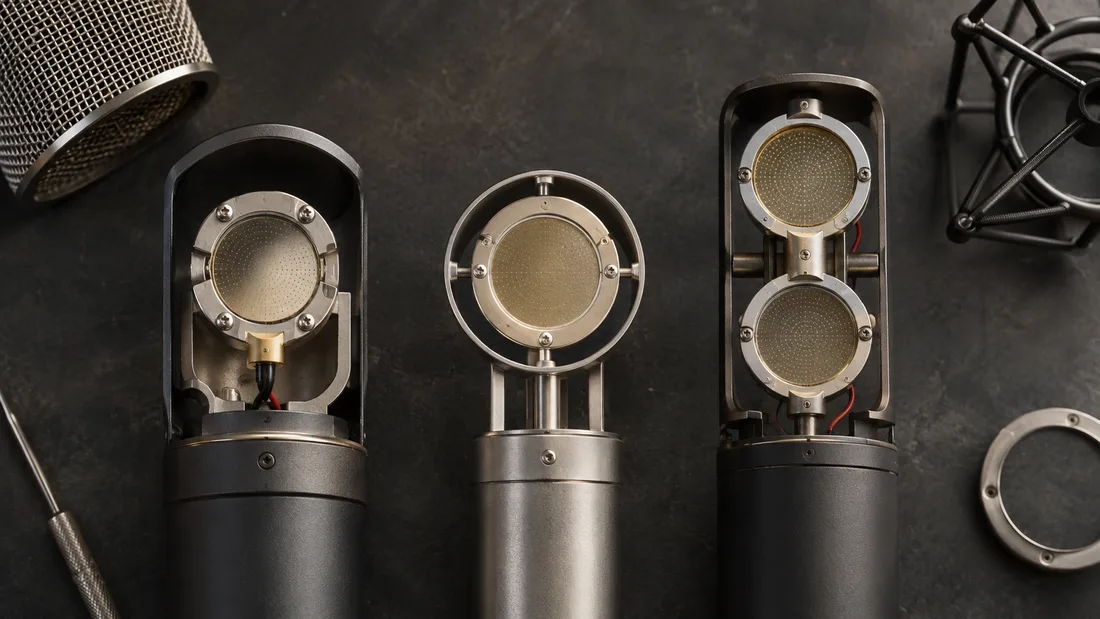
Some large-diaphragm condensers contain a pair of diaphragms and circuitry that permits several directional settings. The convenience of changing a switch without exchanging the entire microphone can teach more than it initially appears. Set up a constant source such as a spoken passage reproduced through a small loudspeaker. Keep the microphone fixed and select several patterns while capturing short examples. For each selection, listen not only to the direct signal but to the character of the reflections and the frequency balance. Output sensitivity may change across the settings, so comparisons should use matched playback levels.
When experimenting with singers, avoid moving the microphone or changing the room arrangement during the first comparison. Only after establishing what the settings themselves contribute should the placements be optimized for each pattern. An omni used farther away in a good room can be far more attractive than an overly close cardioid recording, whereas a different room may make the opposite choice sensible. The choice determines the recorded balance directly, not just the amount of later processing needed.
Why pattern choice matters at mix time
Unwanted sound captured by a microphone may be similar in frequency to the wanted sound. A conventional equalizer will alter both together, which limits its ability to correct bleed or room coloration. Directional selection, repositioning and room treatment operate before this mixture is fixed in the recording. They are especially valuable when an engineer intends to compress a track, because compression can make previously inconspicuous bleed more prominent during quiet passages. A recording that starts with a useful spatial balance tends to remain easier to control throughout editing and mixing. Thinking of each microphone as a three-dimensional response surface, instead of a little device that magically points at something, turns polar patterns into one of the most practical tools in the room.