Equalization is deceptively easy to operate. Choose a frequency, change gain, and the sound becomes brighter, darker, thinner or thicker. The difficulty is knowing whether that change is actually what the recording needs. A low-frequency problem may really be a premature room reflection. A voice that disappears behind a guitar may have plenty of presence when heard alone, yet very little space in the arrangement. Equalization works best when it is an answer to a specific listening question, rather than a substitute for one.
Describe the problem before opening the equalizer
Listen to the track in context and give the issue a name. Is the entire sound too dark, or does one particular note ring for longer than the rest? Is an instrument difficult to hear because it has too little energy, or because another instrument occupies the same space? These are different problems. A dark recording may benefit from a wide, gentle change in tone; a ringing note might require a much narrower adjustment. If the recording already sounds appropriate by itself, the sensible intervention may instead be on its competing part.
The familiar terms used by producers provide a convenient vocabulary, but they are not fixed frequency assignments. Mud, boxiness, harshness and air depend on the instrument and listening system. Mud in a kick drum can have little in common with mud in a piano. A high male voice does not necessarily place the most troublesome resonance at the same frequency as a low male voice. Write down what you hear before guessing the numerical region. This simple discipline makes decisions easier to revisit several hours later.
Use a sweep as a diagnostic instrument
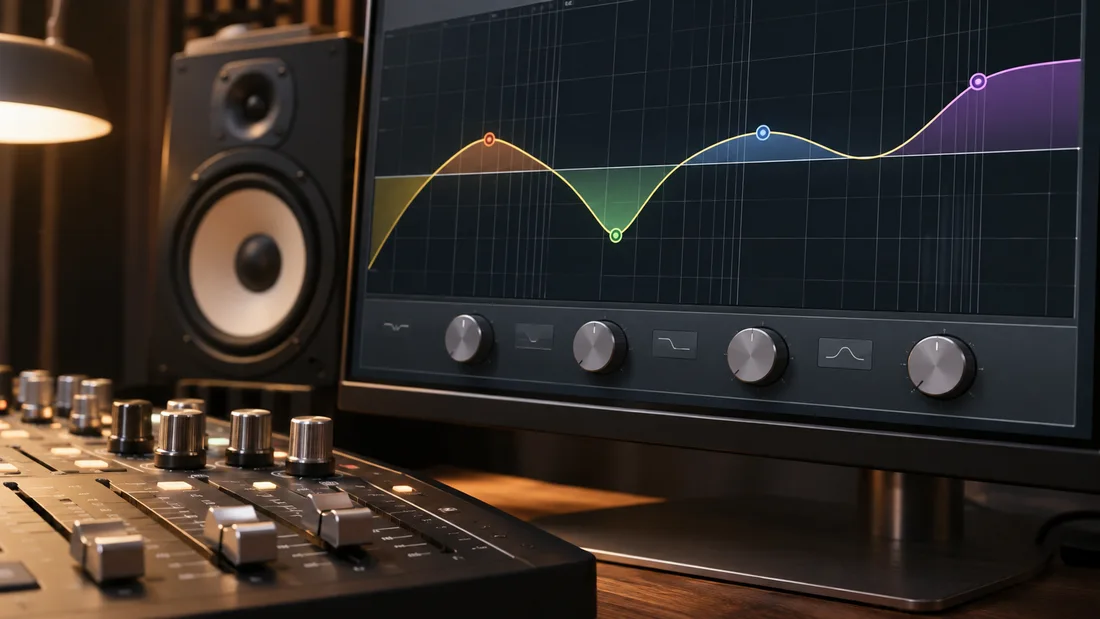
A parametric band offers control over its center frequency, gain and bandwidth. To investigate a suspected resonance, move a moderate boost through the likely range while the material loops. You will hear different components of the sound emerge. Large boosts are useful for locating narrow resonances, although they will inevitably make almost every frequency sound objectionable. Keep the temporary level reasonable, identify the region that resembles the actual problem, then remove the boost. Try a small cut that is just wide enough to address it. Compare it against the original, preferably with the overall output level approximately matched.
Listening for a change in a musical phrase can be more revealing than sweeping a single sustained note. An acoustic guitar might have one note that rings unusually strongly, while neighboring notes sound natural. Cutting that note's frequency deeply would also change the overtones of other notes. A dynamic equalizer, automation, a lighter cut or a new recording position may therefore produce a better result. Not every peak on an analyzer deserves removal. Peaks are an inherent feature of pitched musical material, and the character of an instrument often depends on its uneven frequency response.
When a broad change is more convincing
Broad bell curves and shelving filters are especially helpful for balancing the general color of a recording. Start with a modest gain change and listen over several phrases. A high shelf can reveal the breath and texture of a vocal, or the friction and movement within an acoustic instrument. The same shelf might also reveal hiss, cymbal spill and sibilance. A decrease can make a bright part sit comfortably behind the lead, but too much reduction leaves the performance remote and indistinct.
Think carefully about how a shelf behaves around its corner frequency. Boosting the treble from one point does not isolate only the region above that value, and the transition can affect a substantial part of the sound. The exact shape varies between designs. Two equalizers that appear to offer similar settings may respond differently because their curves, gain interactions and filter definitions differ. Listen to the actual result, not just the display.
Clearing low-frequency space without stripping away weight
High-pass filters are valuable when a microphone captures foot noise, handling, wind or low-frequency energy transferred mechanically through the floor. Setting the cutoff blindly on every track, however, can remove useful musical information. The fundamental of a low instrument may lie below the cutoff, while some of the warmth in a vocal or guitar comes from frequencies near that region. Filters do not act like abrupt boundaries; they attenuate progressively around and beyond the selected frequency.
Find the minimum effective filtering for each recording. Raise the cutoff until the benefit becomes apparent, then determine where the loss of warmth stops being acceptable. Check the result while the bass and percussion are playing. A thin rhythm guitar might sound slightly unattractive in isolation yet fit beautifully next to a powerful bass line. Conversely, a sparse arrangement with just guitar and voice requires the guitar to carry much more of the low-midrange foundation. Good filtering depends on the arrangement as well as the individual source.
Recognize frequency masking as an arrangement issue
Masking occurs when a sound is made harder to perceive by another sound with competing frequency content. It is both a physical and perceptual phenomenon, influenced by level, timing and spectral distribution. Imagine a dense sustained synthesizer playing behind a singer. Increasing the singer's midrange may work initially, but it may also make consonants tiring. A more musical solution could be a modest reduction in part of the synthesizer's midrange, a change to its voicing, a smaller stereo image or a brief reduction in level while the voice is present.
When two tracks compete, test changes to each side of the conflict rather than immediately applying complementary curves. If the two sounds rarely play at the same time, no constant adjustment may be necessary. If their rhythms are similar, a different note length might improve clarity more than equalization. Even a change to the octave of one part can make a crowded mix considerably easier to balance. The equalizer should support the musical decisions already present in the arrangement, not force every instrument into an artificially isolated collection of bands.
Evaluate phase and latency in multi-microphone recordings
Traditional minimum-phase filters often change the phase relationships near the frequencies they alter. This is normally an integral part of the filter response, but it becomes important when several microphones capture the same performance. A filter added to one microphone can change its interaction with the others. For example, an overhead microphone might be capturing a large proportion of the snare drum as well as the cymbals. Equalizing that recording can change the combined snare sound in unexpected ways. Compare the full microphone group before and after adjusting the suspected source.
Linear-phase processing is sometimes selected to avoid the frequency-dependent phase shifts of other filters, but it can introduce latency and pre-ringing depending on the design and settings. It is not automatically more transparent. In ordinary tracking or mixing, the audible significance of those properties depends on the program material, the slope of the filter and the relationship between tracks. It is worth distinguishing a genuine technical requirement from a desire to use an impressive-looking algorithm.
Build a reliable comparison routine
Loudness can make a boosted signal seem more attractive than the quieter original. Use the equalizer's output trim so that switching between processed and unprocessed sound is approximately level-matched. Compare an entire musical section, not only the moment at which you started adjusting the band. Listen at a moderate level, then turn the monitors down and check whether the essential elements remain recognizable. On a familiar pair of headphones, examine noise, plosives and other quiet details that might be difficult to hear in the room.
Finally, leave the mix and return after a break. If you can no longer explain why an equalizer is in the chain, bypass it. Retain the adjustment only when the original issue returns. The value of this test is that it encourages a recording engineer to think about audible outcomes rather than the number of processors used. A technically simple change, confidently selected, can be much more effective than a complicated collection of modifications whose combined purpose is unclear.