A compact integrated amplifier, a portable player and a laptop headphone socket might look as though they have little in common. Each device that reproduces digital audio as sound has to convert sample values into an analogue electrical signal somewhere. The converter may be integrated into a complex chipset, housed in a separate box or located inside a powered loudspeaker. Buying an external digital-to-analogue converter changes where that work happens. Whether the new arrangement improves the music depends on considerably more than the logo on the converter chip.
From sample values to a voltage
Digital recordings represent audio using a sequence of numeric sample values taken at regular intervals. Appropriate reconstruction of a properly sampled and band-limited signal produces a continuous waveform. A playback converter implements that reconstruction through a combination of digital processing, conversion circuitry and filtering, then presents the result to an analogue output stage. An amplifier or an active speaker receives the continuously varying signal rather than individual samples.
A drawing that compares a digitally sampled sine wave to a staircase is easily misunderstood. The individual sample values do not describe the shape that a competently implemented playback system necessarily produces between them. Interpolation and reconstruction filtering are central parts of the process. A higher sample rate creates more room for the transition between the audible band and the filtering stopband, but simply multiplying the sample rate by a chosen factor cannot restore information that was absent from a recording.
Bit depth is a different property. In ideal conditions, increasing the number of bits reduces the level of quantisation error. Dither permits quiet information to be represented without the distortion that can result from correlated quantisation error. Real converter products are limited by electrical noise, available signal voltage and other implementation details long before all theoretical values associated with a large digital word length can be realised.
The converter is also an analogue component
When comparing specifications, include the analogue outputs rather than concentrating exclusively on the part number of the digital conversion circuit. Output noise, distortion, channel balance, filtering, susceptibility to interference and maximum voltage all affect whether a source behaves appropriately when connected to downstream equipment. The available output voltage matters because line-level inputs are not designed around a universally identical maximum.
Some consumer sources produce roughly two volts RMS at full-scale output on an unbalanced connection. A balanced output may supply a larger differential voltage. The fact that a DAC plays louder into the same amplifier at the same dial setting reveals very little about its fidelity. It is possible for a quieter source to be judged as having less bass or detail in a comparison that has not accounted for the difference in electrical level. Set levels closely before listening for subtle distinctions.
Output impedance is another relevant characteristic. A properly designed line output should normally feed the considerably higher input impedance of an amplifier without substantial attenuation or frequency response deviation. A headphone output has a different task. It must supply the current and voltage needed by the transducer while keeping distortion and output impedance sufficiently low. A DAC with a headphone socket combines the converter with some form of headphone amplification. A pure line-level DAC may not be able to drive a low-impedance headphone at all.
Choose an input according to the source equipment
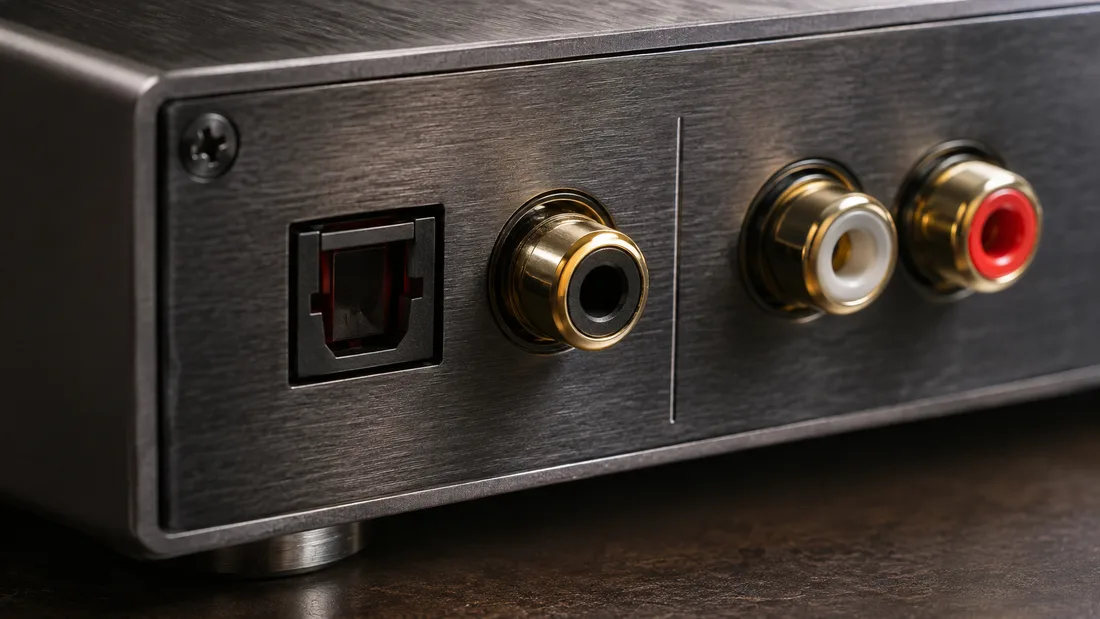
Optical and electrical S/PDIF became familiar connections for digital stereo equipment long before desktop USB DACs became common. An optical input is especially convenient when a television acts as a digital source. Its fibre provides an electrically isolated signal path that can avoid certain ground-loop problems. The cable's operating range and supported data formats still depend on the capabilities of the sending and receiving equipment.
Coaxial S/PDIF carries the digital signal using an electrical transmission line. Both forms embed timing information in the interface signal. The receiving device derives a clock from the incoming stream or transfers the data into its conversion system through an appropriate buffering and clocking arrangement. An external clock is not an automatic cure for timing errors. Its useful role depends on the existing architecture and its capacity to manage the timing of the actual conversion.
A USB audio connection allows a computer to deliver audio samples to a compatible device. Equipment using widely supported USB audio class implementations can often run with an operating system's existing driver, although certain modes and options may require dedicated software. The computer's mixer may combine system sounds with music, adjust volume or resample the stream to match a selected device rate. That behaviour belongs to the playback system, not to the audible signature of the DAC chip.
Investigate faults before comparing hardware
Consider replacing the built-in audio output when a clearly audible noise is present. A computer that produces a changing high-pitched sound through its analogue connection as the graphics processor or display is active is a useful example. The audible problem could result from coupling into the analogue stage or a grounding connection. Moving conversion to a shielded external box may help, but an electrical connection through a different USB cable does not guarantee that every ground-related problem disappears.
Listen with the source paused and the amplifier set to a normal listening level. If the noise remains, identify whether it comes from the amplifier or the selected source. Disconnect a suspect analogue cable with the equipment muted or powered down and try another input. Some interference is carried by connected devices, while other noise comes from excessive gain in the amplifier itself. A DAC upgrade cannot repair an unrelated noisy phono input, defective loudspeaker or overload elsewhere along the signal path.
A compact external interface may also fix a connectivity problem. It could supply a balanced output to studio monitors, a dependable volume control for desktop listening, switchable optical inputs or a remote-operated interface for a seated listener. Those are practical performance improvements even if the original converter already reproduces an undistorted analogue signal.
What measurements tell us
Published distortion and noise measurements are worth reading in context. A report of total harmonic distortion and noise at a particular output level generally combines harmonic distortion products with unrelated noise in the measurement bandwidth. A low value indicates that the resulting non-signal energy is small under those test conditions. It cannot reveal every independent property, such as the action of a volume knob near its lower limit, muting behaviour during a digital format change, or the residual interference produced by one particular connection to a computer.
Dynamic range measurements establish how much quiet information can be represented above the device's own noise under stated conditions. For many home systems the acoustic background, loudspeaker sensitivity and actual listening level determine whether further improvements in this respect would be audible. A noise figure measured through a line output is not necessarily the figure for its accompanying headphone stage. Check which output, load, bandwidth and voltage correspond to the result.
A separate measurement of the reconstruction filter can establish how the converter handles frequencies towards the top of its operating band. Differences at frequencies beyond hearing do not automatically produce corresponding audible distinctions. Claims based on tiny discrepancies should be investigated through controlled comparisons, preferably using matching levels and the same underlying master.
Make the buying decision concrete
Write down which source devices must be connected, what the next component expects, how volume will be controlled, and whether an audible fault has actually been identified. A newcomer setting up a basic network player and integrated amplifier may already have all the conversion circuitry required. Someone building a computer-based system around powered monitors may save considerable trouble through a better interface with convenient connections.
When the only purpose of another box is to obtain a speculative improvement in sound, arrange an audition against the existing source. Keep programme material, loudness, filtering and downstream equipment consistent. If the difference is inaudible under those circumstances, the money may achieve much more by improving the room, the loudspeakers or the comfort of the headphones. Digital conversion is essential to the system. The external DAC is an optional way of implementing it.