Streaming transformed the collection of recordings accessible to a listener without making the signal path visible. Choose an album on a phone, press a button, and sound may emerge from a network player on another continent of the domestic Wi-Fi network. Somewhere in that sequence a service chooses a file, an application decodes it, and an audio device reproduces it. Asking whether a streaming setup is lossless is a question about those transformations, not merely the quality badge shown beside an album.
On May 17, 2021, Apple announced that lossless audio and a spatial audio offering would become available to Apple Music subscribers beginning the following month. The announcement brought lossless streaming into another mass-market subscription service.
Three different kinds of digital file
Uncompressed PCM stores the sampled audio values directly in a suitable container, together with any metadata the container accommodates. Its storage requirement can be estimated from sample rate, channel count and the number of bits per sample. Two-channel 16-bit audio at 44.1 kilohertz entails about 1.41 megabits of sample data per second before container overhead. The maximum rate of a home internet connection is commonly much greater, but a streaming service must operate under a wide range of real connection conditions.
A lossless compression format such as FLAC represents the same samples in a more compact form. Decoding an intact FLAC file yields the original audio samples, without missing instrument parts or an altered frequency balance. The degree of compression varies with the material. A very quiet simple passage is easier to compress than a dense passage with wide-band noise. Lossless compression is not a promise that every release in a service catalogue was made from the original studio session.
Lossy perceptual coding reduces data requirements by using models of audible masking and other properties of hearing. At sufficient bit rates and with a good encoder, differences between the decoded lossy stream and the corresponding original can be difficult to identify in normal listening. Severe compression or difficult material may reveal a loss of fine texture or unnatural changes around transients. The same nominal bit rate can perform differently when the codec or encoder changes.
Why the master matters more than the badge
Two files can present different versions of the same piece of music even if their titles, dates and album artwork appear alike. An older transfer may have been made with a different mix, equalisation or peak limiting from a later remaster. Another version might be a new stereo mix prepared decades after the original. Those changes are already present before the audio reaches the encoding stage.
A highly compressed perceptual stream of a preferred master can be more enjoyable than a lossless stream of a remaster whose dynamic range has been heavily altered. That comparison does not refute the advantage of retaining the original samples. It demonstrates that the mastering decision and the method used to deliver its result are independent variables. High-resolution lossless audio is an excellent delivery mechanism, but it cannot retrospectively improve engineering decisions encoded in the master.
When a familiar recording sounds different through two services, check duration, credits, version labels and release information. Even the same named edition may have undergone a quiet catalogue replacement. Level matching is necessary if one copy is simply louder, and rapid comparison is easier when the source files have been shown to contain the same performance and mix.
What high resolution adds to the discussion
A stream labelled high resolution generally uses a sample rate, a bit depth or both that exceed the commonly used CD specification. In production, higher word lengths provide greater operating margin when working with many sources and repeated processing. Higher sampling rates can be useful within suitable workflows, including some processes that generate new harmonic content and deal with filtering. Such advantages do not establish that the listener can distinguish every consumer release at a higher resolution from a properly made standard-resolution version.
Some high-resolution masters were derived from older analogue recordings. The transfer process, preservation of the tape, and transfer equipment may influence the result more than the numerical label. Some digitally recorded material cannot gain detail in its older source simply because a file has subsequently been upsampled. High-resolution delivery is an attractive property when a service offers the desired master with no additional cost or operational difficulty. It need not be treated as a separate genre of sound.
Follow the path after pressing play
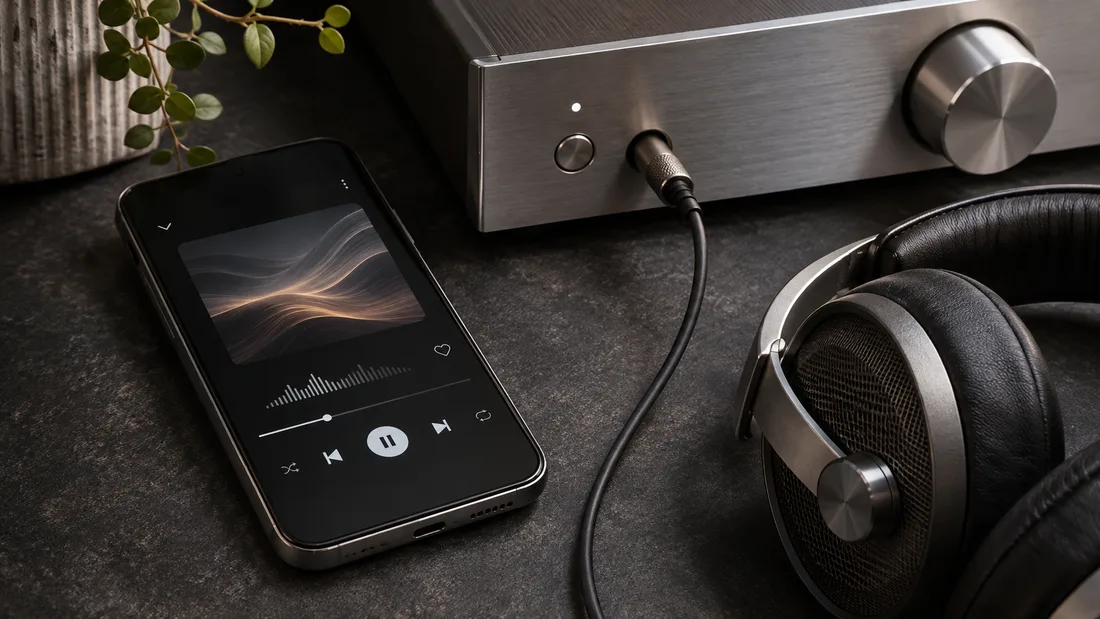
A service application may be running on the phone itself or controlling playback on a separate device. In the latter arrangement, the receiving player can obtain the stream directly, with the phone acting as a remote control. In a different arrangement the phone receives, decodes and transmits audio through another connection. Those approaches have different possibilities for format conversion and interruptions.
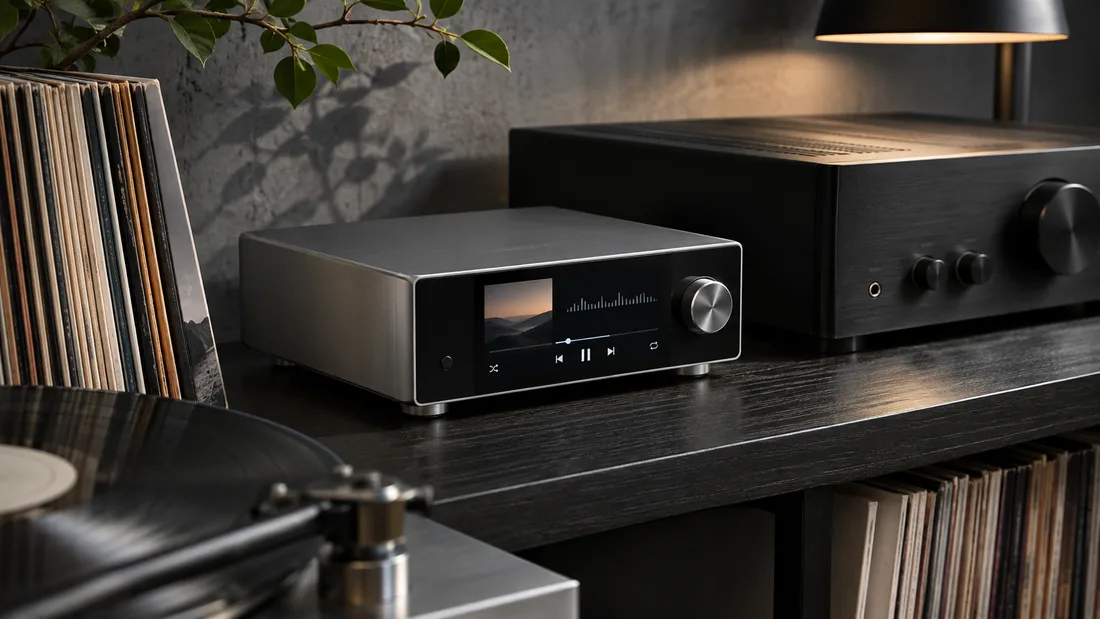
Bluetooth playback deserves particular attention because many Bluetooth audio configurations use perceptual compression. The lossless stream received by the phone might be decoded and then encoded again for the wireless connection. Capability labels must be interpreted with the matching devices, selected modes and actual connection conditions in mind. A separate network player with a wired or Wi-Fi network connection can receive and play supported lossless files without requiring this additional Bluetooth encoding.
A computer presents another set of choices. A service's application can direct decoded audio into the operating system's general audio mixer. The mixer may resample to a fixed rate, incorporate notifications, adjust volume or apply sound enhancements. That can be perfectly adequate for listening, but it is not necessarily a sample-identical route from source to converter. A compatible exclusive playback mode can avoid certain shared processing. Check whether an apparent discrepancy originates with those options before buying new hardware.
Volume normalisation and equalisation
Recordings prepared for different purposes have different average levels. Without normalisation, moving from an intimate acoustic recording to recent heavily limited music may prompt a hurried reach for the volume control. A normalisation system uses loudness information to adjust playback gain, with the precise treatment depending on the service and mode. Gain adjustment is distinct from the studio process of dynamic range compression. Reducing the gain of a loud master does not restore peaks lost during mastering, but it may allow fairer comparisons.
Digital equalisation is also a rational part of a listening system. A carefully chosen filter can reduce an irritating headphone resonance or a prominent peak caused by a listening room. Calling the original stream lossless remains correct as a description of the encoding and decoding process; the deliberate processing after decoding modifies the samples for a purpose. Insisting on bit-perfect transmission while also enabling equalisation is an inconsistency in terminology, not evidence of a malfunction.
Prevent interruptions without overspending
A network player needs dependable data delivery rather than an audiophile grade network switch. If high-quality streaming sometimes stops, inspect the wireless signal at the device, test a suitable wired connection where possible and determine whether several household activities are competing for limited bandwidth. Packet transmission errors usually manifest as buffering, dropouts or failed playback rather than continuous changes in the tone of a successfully decoded file.
Use downloaded offline files when a mobile connection is unstable. Wi-Fi roaming, power-saving modes and operating system behaviour can cause interruptions even in a house with a fast internet subscription. Keep playback software current when compatibility problems have been identified, but distinguish a failed application update from an issue with wireless coverage.
Listen beyond the technical setting
Turn on lossless playback if the service, hardware, connection and data allowance make it convenient. Check that the chosen network or wired playback route supports the intended format. Set an appropriate listening volume, disable unwanted effects, and preserve useful correction filters if they improve the system. Then listen to complete recordings rather than repeatedly hunting for differences between format indicators on a display. Lossless transmission retains the samples supplied to the encoder; selecting the right music, master and means of reproduction determines what those samples mean in the listening room.