A subwoofer that is integrated well is surprisingly easy to overlook. The bass instrument follows notes of its own rather than being replaced by a regular thud, and a bass-rich recording does not sound unexpectedly detached from the rest of the performance. Achieving that effect in stereo usually requires a relationship between speaker placement, the crossover filters and the listening seat. The subwoofer's size and reputation reveal much less about the final response than the way the principal speakers and room contribute across the transition.
A subwoofer has two potential jobs
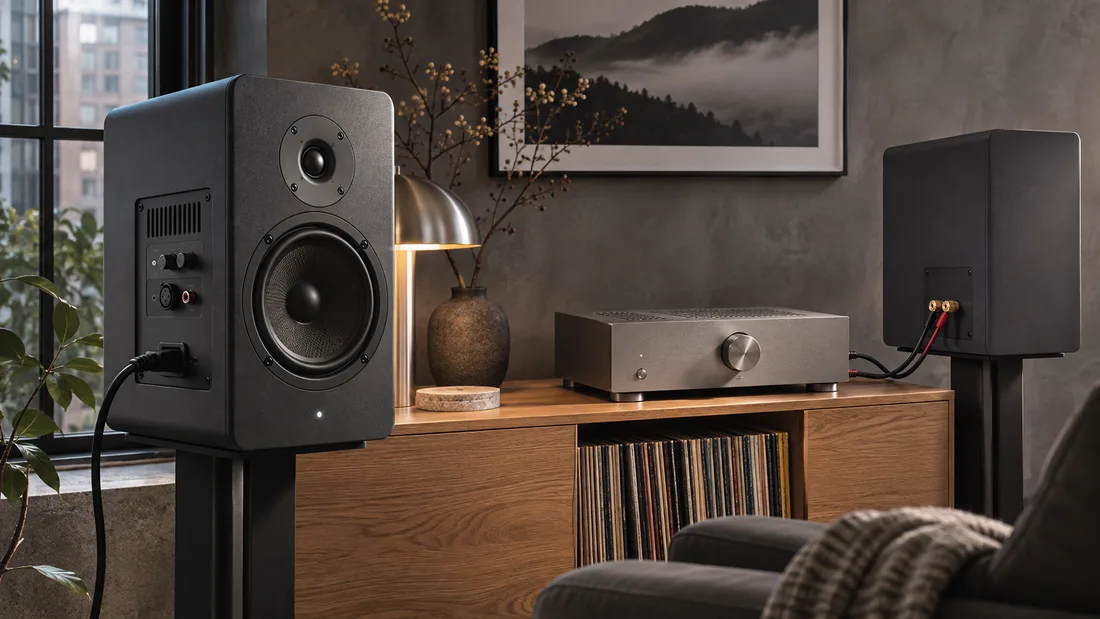
In a system using small bookshelf loudspeakers, a different enclosure and larger driver can extend the usable low-frequency response. The listener hears more of sustained bass instruments, large acoustic spaces and the lowest effects on recordings. There is also an opportunity to improve the main loudspeakers' headroom. If an appropriate high-pass filter removes some bass from the main inputs, their drivers do not need to travel as far to reproduce it. That may reduce certain forms of distortion at substantial volume.
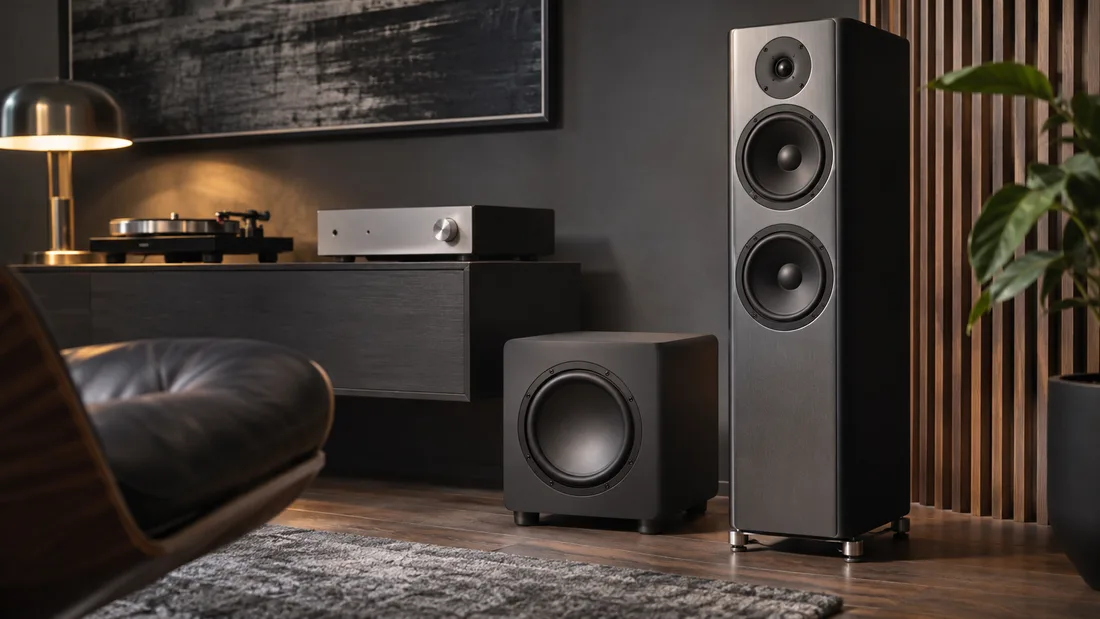
A system with larger floorstanders can still benefit from subwoofers, though not necessarily for greater depth. The room places strong constraints on where low-frequency energy reinforces or cancels. The positions that establish the best stereo image are not always those from which the smoothest bass can be obtained. Giving the low-frequency drivers a degree of placement independence can address the problem, particularly if the speaker signals are appropriately filtered.
Simply adding a sub while the main speakers remain full-range is a legitimate option if a system has no practical high-pass facility. It presents a more complicated overlap. The sub and speakers reproduce some of the same notes with their own amplitude and phase responses. A correct setting in that situation cannot be taken directly from a system that uses complementary filters.
Decide how the signal will reach each enclosure
Many domestic amplifiers have a mono subwoofer output whose exact behaviour varies. It may carry a low-passed signal controlled by the amplifier's volume, or a largely unfiltered combination of the stereo channels. Other products provide managed bass routing and a corresponding high-pass filter for the main channels. Inspect the documentation before setting the filter frequency on the subwoofer itself.
Connecting two independent low-pass filters in series, for example by activating both a receiver's crossover and the filter on the subwoofer, changes the combined response and can introduce more phase shift. Suitable subs provide a bypass option or dedicated input intended for an already-filtered signal. A receiver with a home cinema low-frequency effects output may behave differently during ordinary stereo playback from its behaviour with a multichannel soundtrack.
Where no dedicated output exists, an appropriate subwoofer with high-level inputs may accept a reference from the amplifier's speaker outputs. Not every high-level circuit is compatible with bridged or floating-output amplifiers. Follow the amplifier and subwoofer manufacturers' instructions. Never join output terminals to construct a mono signal unless the connection is specifically supported.
Begin with a placement that allows adjustment
At low frequencies the wavelength in air is long compared with the dimensions of the cabinet, so a subwoofer can interact strongly with several boundaries regardless of the direction its driver faces. Placement near a corner tends to increase output in parts of the bass range, but it can also excite resonances that dominate the listening position. Moving towards the middle of a wall can suppress or alter particular modes. The results depend on room dimensions and the position of doorways, furniture and other boundaries.
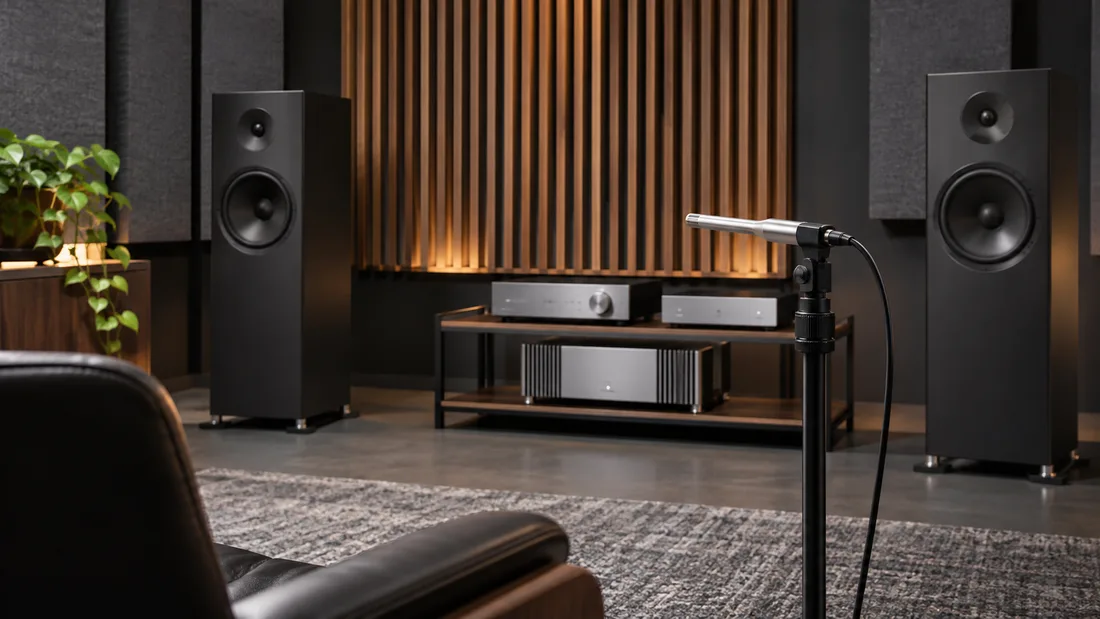
One practical search method is acoustic reciprocity. Place the sub temporarily near the listening position, play a sequence of low-frequency signals at moderate level, and assess potential locations around the room at corresponding heights. A position that yields a relatively even response may be promising when the sub and listener exchange places. The real installation still needs verification; the approximation is affected by the exact locations, the listener's movement and whether the main speakers contribute during assessment.
Prioritise combinations without extremely deep cancellations. A prominent peak may be amenable to a cut using equalisation. Trying to fill a cancellation with aggressive electrical boost consumes headroom and may create excessive bass elsewhere. It also places extra demands on driver excursion.
Choose the crossover through the transition band
Look at the low-frequency response of the main speakers. A quoted bass limit often describes the frequency at which response has fallen by a specified number of decibels, not an abrupt cutoff. A crossover at precisely that published frequency is not always optimal. A higher crossover can reduce the demands on small speakers and may provide a useful overlap, provided the sub is capable of reproducing the upper end cleanly without revealing distracting noise or distortion.
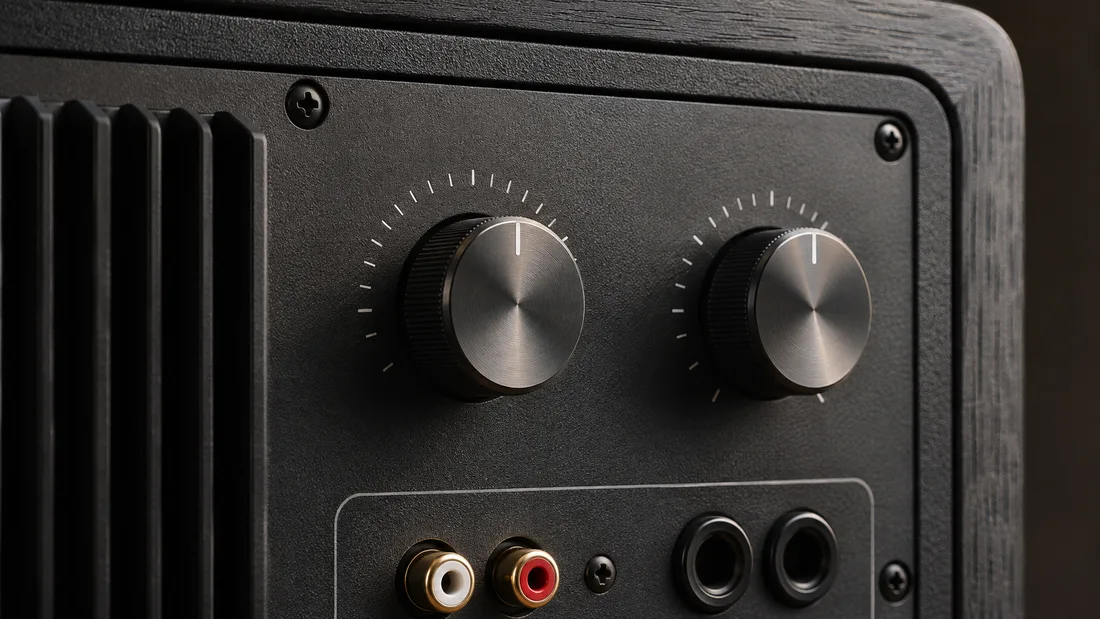
A starting point around 80 Hz is often appropriate when a system has conventional managed filters and compact main speakers, but the correct choice is dependent on the equipment and room. A small satellite may require a higher setting. Large speakers intended to continue deep into the bass may work with a substantially lower transition when no high-pass filter is available. Listen and measure across the range rather than deciding from the knob markings alone.
The crossover setting does not describe the entire acoustic slope. The natural roll-off of each loudspeaker combines with the electrical filter and the room's response. Two nominally identical crossover frequencies may produce different combined outcomes. This is why measurements at the listening position are valuable.
Align the two contributions in time and level
Subwoofers often provide phase or polarity adjustment. Reversing polarity swaps the sign of the signal; a variable phase circuit can introduce a frequency-dependent change. A bass management system with distance or delay parameters can adjust arrival time. These controls are not all interchangeable. Their effect depends on position, filter response and the physical design of the equipment.
Use a measurement near the crossover to compare the main-speaker response, the subwoofer response and their combined output. If the combined response is considerably lower than either individual contribution in the transition region, some destructive interference is occurring. Changing polarity, delay or the crossover arrangement may improve the summed response. Confirm the result over a band of frequencies instead of at one tone.
Set the final level from a series of recordings or a properly averaged measurement. A sub that seems spectacular with one recording may overpower the next. Pay particular attention to voices: if dialogue or lower vocal notes become conspicuously thick with the sub enabled, the transition may be too high or the upper-bass region may be excessive.
What more than one sub can accomplish
Two appropriately placed subwoofers can excite the room's modes differently. The combined response may become smoother across several seats, depending on locations, delays, equalisation and how the system routes the signal. This can be more useful than concentrating additional cone area in one cabinet position. Simply purchasing another identical model without a plan for placement and adjustment does not establish the benefit.
For a shared listening space, sample several positions around the intended seats. Avoid optimising one perfectly flat trace at the expense of a severely uneven response in the adjacent chair. A moderate variation distributed across a useful listening area is often preferable to a narrow correction that depends on a fixed head position.
Finish with music, not another test tone
Listen to several acoustic bass notes played at visibly different pitches, a close recorded kick drum and a piece with genuinely deep sustained energy. Turn the sub off briefly and compare how the scale and consistency of the programme change. It may take several evenings to recognise whether the bass is persistently loud, whether notes linger too long, or whether the original speakers' midrange becomes cleaner with high-pass filtering. Keep a record of positions, filters, phase and volume so a successful combination can be restored. The point is to reproduce more of the recording without announcing that a new device sits in the room.