The first upgrade to a stereo system may involve moving the equipment rather than replacing it. A loudspeaker creates a field of direct and reflected sound, and the proportion reaching each ear depends on where the cabinets stand, how they are angled, and where the listener sits. Even excellent loudspeakers cannot establish a convincing central image if one is pressed into a corner while the other faces an opening to a hallway. Placement is a set of manageable decisions, not a ritual requiring a perfectly dedicated room.
Start with the listening position, not the walls
In a conventional two-channel setup, the listener should receive reasonably similar direct sound from the left and right speakers. A rough starting point is a triangle in which the speakers are separated by approximately the same distance as the listener is from each cabinet. The triangle need not be precisely equilateral. A narrow room, for example, may favour speakers spaced 1.8 metres apart and a chair 2.2 metres from their front faces. The objective is to establish a coherent stereo image without making the centre feel hollow.
Measure to a consistent point on each cabinet, then check the midpoint of the listening position. The measurements do not guarantee identical acoustics, but they remove one avoidable source of asymmetry. In many homes the sofa is against the back wall, putting the ears exactly where the room reinforces particular low frequencies. Move it forward where possible. If a sofa cannot move, test a separate chair before deciding that the speakers themselves are too bass-heavy.
Understand what the rear wall does
At bass frequencies a speaker radiates in almost every direction. The sound travelling towards a nearby wall reflects and rejoins the direct radiation. Depending on the frequency and the distance between speaker and boundary, the two signals reinforce or partially cancel each other. A deep cancellation caused by the interaction is notoriously difficult to correct with an equaliser because boosting the speaker also increases the reflected contribution.
Moving a cabinet changes this relationship. Try positions differing by ten or twenty centimetres and make notes on familiar bass lines and kick drums. Distances should be measured from the same point, preferably noting both the cabinet and the sound-emitting front baffle. A port at the back certainly needs clearance, but the position of the port is not the whole story. The acoustic boundary interacts with the output of the entire speaker, including sealed designs. The instructions that accompany a particular model may identify useful minimum clearances.
The closer a speaker moves to one boundary, the more important it becomes to check the listening position again. If practical, avoid assuming that both cabinets must be the same distance from their nearest side wall in an asymmetrical room. This is a compromise between symmetry of direct sound and a tolerable bass response, not an architectural drawing.
Use toe-in as an adjustment rather than a rule
Toe-in describes rotating each speaker towards the listener. Many designs produce a treble response that changes as the listening angle moves away from the principal axis. Pointing the cabinets more directly at the ears can increase the proportion of direct high-frequency energy and reduce some side-wall reflections. Depending on the speaker, the result may be greater clarity or an excessively prominent top end.
Begin with the cabinets facing forward. Play a recording with a voice near the middle, then rotate both speakers a few degrees and listen again. Keep the voice at the same loudness, because louder reproductions frequently seem more detailed even when their meaningful information is unchanged. The useful range is usually obvious after several steps. A strong centre image, natural vocal tone and stable localisation when the head moves slightly are better indicators than whether a laser can be aimed at the exact centre of a seat.
Some loudspeakers were specifically designed for a fairly broad listening angle, while others use controlled directivity. For a home shared by several listeners, consider how the listening experience changes across the sofa. A narrow sweet spot is not automatically a sign of better stereo reproduction.
Separate early reflections from the character of the speaker
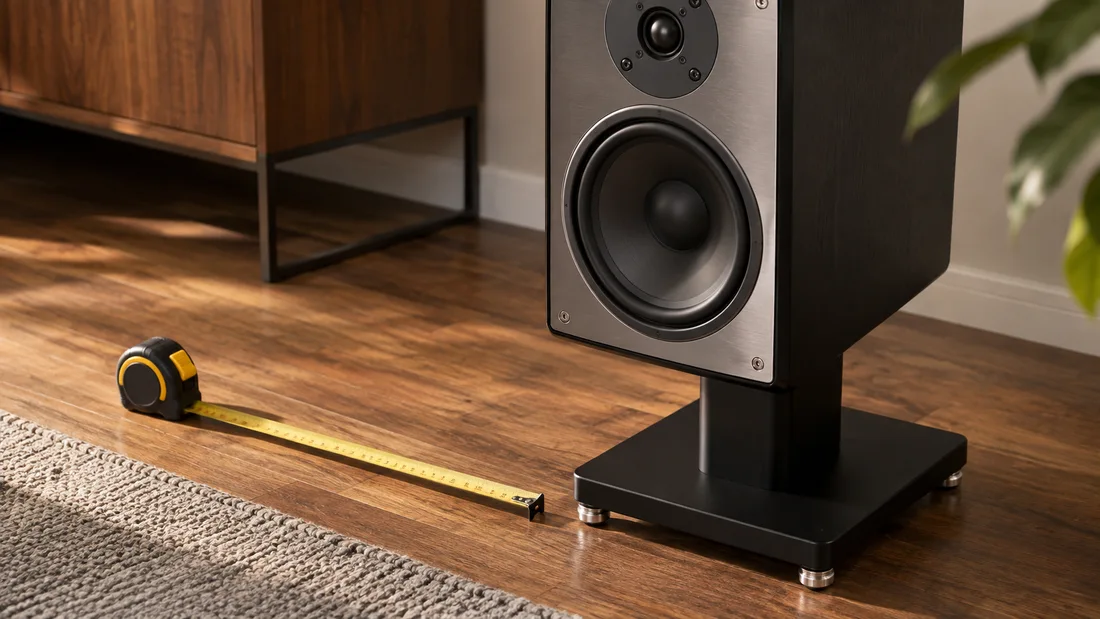
A flat hard surface close to a loudspeaker sends a measurable reflection towards the ears. Glass, plaster and polished floors return substantial high-frequency energy. A reflection arriving a few milliseconds after the first sound can alter both the perceived timbre and the fineness of the stereo image. Yet a sterile room that removes almost all high-frequency reverberation may sound equally unnatural.
Try a reversible adjustment. Close thick curtains during one listening pass and reopen them for a second. A temporary rug may change floor reflections, though its effect will be much stronger at shorter wavelengths than in the bass. Try moving a bookcase or removing an object beside one speaker. The aim is to identify which surface matters before purchasing acoustic treatment. A bookshelf is not a substitute for a carefully designed bass absorber, but irregular furniture can make an ordinary space less reflective in the upper range.
When speakers stand close to large desks or TV cabinets, the top of the furniture can become a prominent reflecting boundary. A stand that places the speaker slightly above that surface, with the front baffle near the front edge of the cabinet, can prevent a strong reflection off the strip of furniture ahead of it.
Get the height and stability right
Place the drivers in the height range intended by the designer. For many conventional two-way loudspeakers, the tweeter at seated ear height is a workable start. A three-way design or a concentric driver can have a different reference axis. The response around the crossover may change markedly above or below this direction, which matters if equipment has been placed on very tall shelving.
Stable supports are more important than mysterious materials. Put a compact speaker on a stand that cannot readily tip and use the recommended mounting arrangement. A heavy cabinet supported by a wobbly stand introduces genuine practical problems. On suspended wooden flooring, some forms of coupling can transmit vibration to the structure; suitable resilient pads are worth trying if the floor resonates with bass. On an inert concrete floor, the same problem may be absent. Expensive spikes cannot correct a fundamentally unstable location or a room cancellation.
Listen across three kinds of recordings
A solo singer with sparse accompaniment provides an excellent image check. The singer should not appear stuck to the closest speaker or change position whenever the volume changes. For bass, use a recording with several distinct sustained notes rather than a single massive effect. Listen for notes that swell conspicuously, vanish, or stay audible long after they should stop. Finally, choose something like a small ensemble recorded in a physical space. Differences in the apparent width and depth of the instruments are easier to establish when the instruments are recognisable.
Absolute image width is not the sole objective. Some records contain instruments panned hard to the sides; others create their stage with the natural arrival-time differences between microphones. Forcing every mix to appear wide and diffuse at home destroys precisely the distinctions encoded by the recording engineers.
A listening room that still functions as a home
Keep a small diagram and mark one or two preferred speaker positions with discreet removable tape. The process saves time when furniture is rearranged or a cabinet has been moved for cleaning. Set aside the urge to make permanent acoustic changes until the basic geometry has been examined. Often the greatest gains are found in a modest adjustment: giving one speaker a little extra space, bringing the seat away from the rear wall, or rotating the cabinets by several degrees. A useful stereo is compatible with the room and the people who live in it.