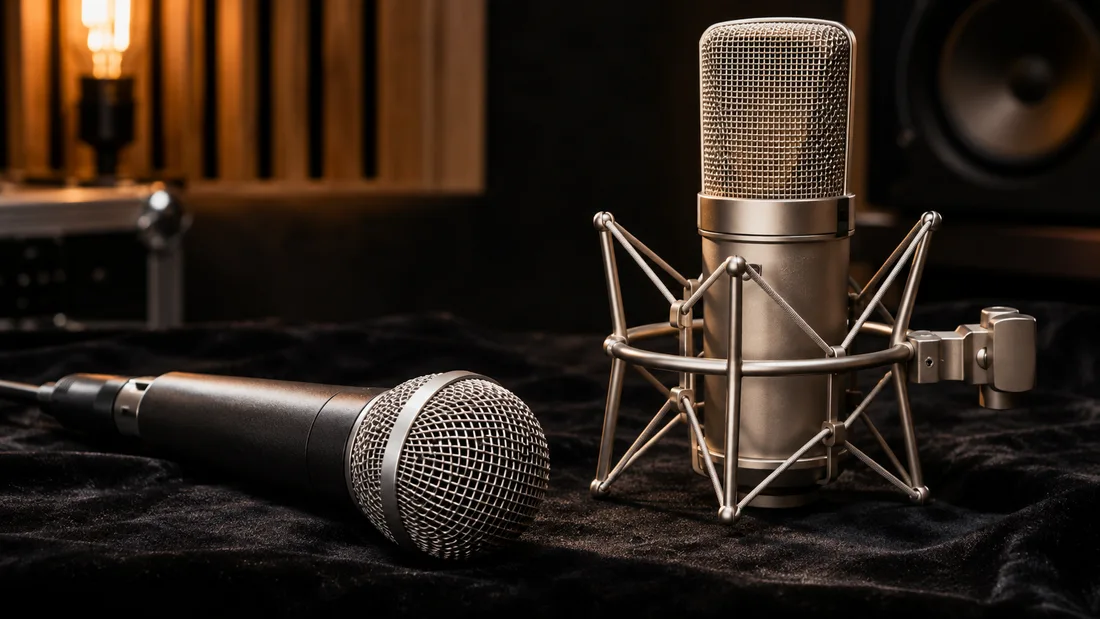
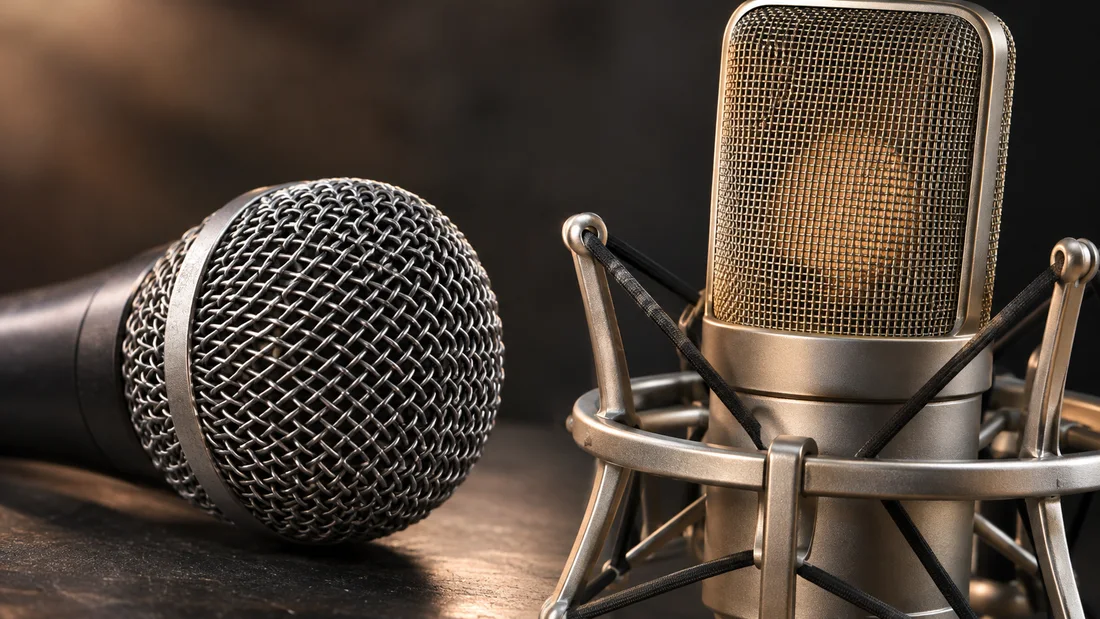
A small collection of microphones can accomplish a surprising amount of recording work. One moving-coil dynamic microphone and one reasonably quiet condenser already present two distinct approaches to capturing the same source. It is tempting to reduce their differences to a simple ranking, with a dynamic regarded as a microphone for a stage and a condenser regarded as a microphone for a studio. That shorthand leaves out much of the reason that experienced engineers keep both types within reach.
Two methods of generating a signal
Imagine a very fine wire coil suspended in a permanent magnetic field. Attach it to a diaphragm and the motion of the diaphragm creates an electrical voltage across the coil. This is the familiar arrangement inside a moving-coil dynamic microphone. No external power is necessary for a conventional passive example. The diaphragm, coil, suspension and acoustic chambers have mass, stiffness and mechanical damping; their combined behavior determines how the microphone follows pressure variations.
A conventional condenser works very differently. A conductive diaphragm and a fixed plate form a variable capacitor. Their changing separation as sound reaches the diaphragm causes an associated electrical change. A circuit inside the microphone converts the tiny high-impedance signal into a usable output. Many modern condensers receive power through their ordinary balanced microphone cable. Some electret designs retain a polarization charge in the capsule material, yet still require power for the active circuit. Tube condensers commonly use separate supplies rather than relying on ordinary phantom power.
The light diaphragm of a condenser makes it possible to design a microphone with wide frequency response and considerable sensitivity. But diaphragm material by itself does not describe a recording. An excellent moving-coil microphone can have a well-controlled response on an instrument, and a poorly designed condenser can accentuate troublesome resonances. The other mechanical and electrical choices inside each product deserve at least as much attention as its category.
Distance changes the apparent difference
In a room containing a singer and a computer, bring a dynamic microphone close to the singer and the wanted signal becomes considerably stronger in relation to the noise arriving from several metres away. The result can sound remarkably dry. Put a cardioid condenser at the same point and compare the recordings after matching their levels. Provided the two polar patterns are reasonably similar, the gap in room rejection may be much smaller than expected. Sensitivity determines how much electrical output a microphone produces for a given sound pressure. It does not make the microphone magically hear farther down a corridor.
There is a useful exception in ordinary workflow. Many dynamic microphones are comfortable to use very close to the lips. Some come with grilles and internal foam intended for that distance, while a suspended, side-address condenser may be positioned farther away with a separate pop screen. The comparisons musicians hear online sometimes confound the resulting placement differences with the electrical principles. It is perfectly acceptable to favor a dynamic because it encourages the performer to adopt a technique appropriate to an uncontrolled room. Just understand why it is helping.
Acoustic guitar, brass and amplified instruments
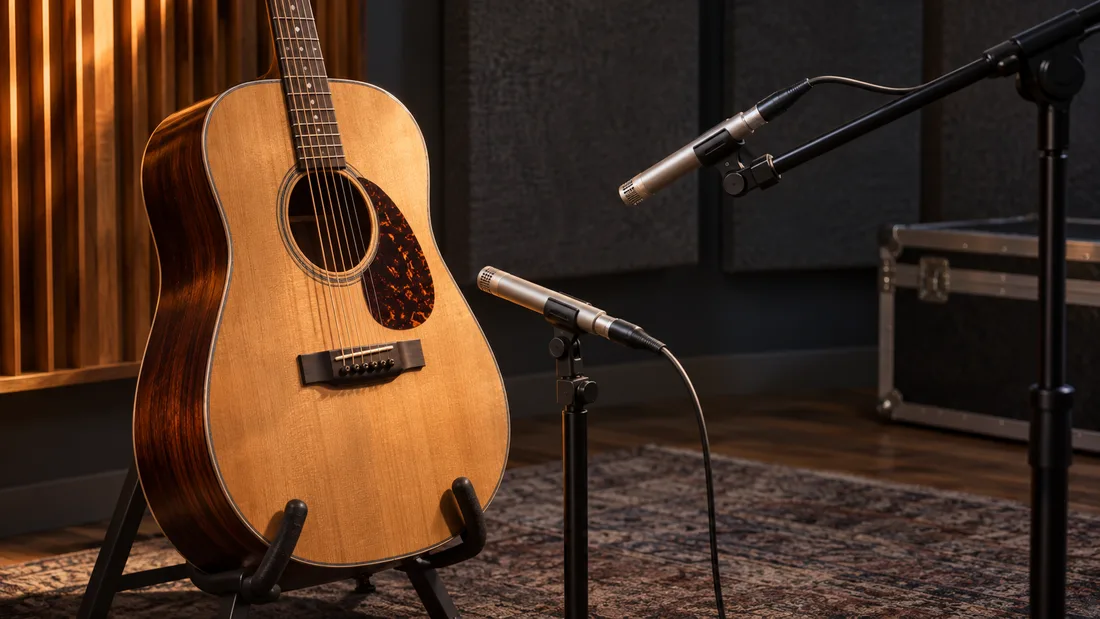
An acoustic guitar has a complex radiation pattern. The upper frequencies produced by the strings and pick differ considerably in direction from the body's lower and middle frequencies. A small-diaphragm condenser placed somewhere near the neck-body joint may capture considerable detail without needing to be almost against the wood. This can be useful when the musician plays softly. A moving-coil dynamic used nearby can instead emphasize a more concentrated midrange and may suit a dense arrangement with many layers. The sound should be judged from its position in the song rather than according to which recording reveals the finest isolated finger noise.
In front of a brass player or guitar cabinet, the availability of sensitive condenser outputs becomes less important. The sound pressure itself provides ample energy. A dynamic is often simple to position, and many common examples handle powerful signals without complicated accessories. Condensers have their own maximum sound-pressure ratings: some tolerate very loud sources, while other models can be overloaded in the capsule or internal amplifier. Where a condenser includes a pad, check the documentation to see how attenuation is implemented. A pad before vulnerable electronics can prevent overload there; reducing gain at the recording interface cannot undo distortion already created inside the microphone.
Pay attention to the preamplifier
Dynamic microphone sensitivity varies, but low-output examples used on speech or quiet instruments often need substantially more preamplifier gain than a typical active condenser. Increasing the gain raises the microphone signal and whatever electrical noise accompanies it. A useful preamp has sufficiently low input-referred noise and enough gain to handle the expected level. The relevant question is not simply whether turning a control to its maximum looks alarming; it is whether the resulting signal contains acceptable noise, whether peaks can be recorded without clipping, and whether there is enough range left for unusually quiet passages.
A condenser has its own noise contribution because the active electronics generate noise even without an audible signal. Manufacturers commonly state an equivalent noise level using an A-weighted measurement. In practical circumstances, air movement, a refrigerator or plumbing behind the wall can easily exceed the microphone's self-noise. Pay special attention to the sound of the empty room through headphones before investing in equipment to improve a particular specification. Likewise, a meter that reaches a modest level is not evidence of inferior quality. A modern 24-bit interface allows generous headroom rather than requiring the recording engineer to drive every signal almost to full scale.
Making the choice for voices
A singer working close to an end-address dynamic microphone may move it naturally while maintaining an intimate sound. The grille offers a physical reference for maintaining distance and the performer can hear a familiar monitoring balance. For a studio vocal that depends on soft consonants, breath or a subtle change in register, a condenser used in a quieter room may offer a different and useful perspective. Neither style must sound unnatural. Depending on the source, a less extended high-frequency response can reduce the need for de-essing later, whereas accurate reproduction of fine consonant detail may be desirable when lyrics need to remain understandable over strings.
Before settling on either microphone, make two short recordings of the same passage, including the loudest and quietest phrases. Establish a sensible gain setting and place the microphones similarly, while avoiding any temptation to have two grilles block one another. Match the clips' playback levels with faders. Listen for the balance of consonants, vowel resonance and low-frequency distance changes. Check the recordings in the complete arrangement as well as alone. The apparent excitement of a louder playback is an unreliable basis for purchasing or choosing recording equipment.
What to buy first
A practical decision depends on the sources available and how the room is used. For a shared living space, a robust end-address dynamic microphone can cover speech and many close-recorded instruments. For an acoustically treated room with acoustic instruments, a versatile cardioid condenser makes a logical first addition. Consider whether suspension, a pop screen, a stand, extra cable and a compatible preamp will be needed, because the total system often determines whether a cheap microphone purchase proves convenient.
When the collection grows, remember that microphone specifications only describe certain aspects of performance. A carefully positioned entry-level microphone can be more useful than an exquisite example placed where the sound is awkward. During a trial, it is generally faster to move a microphone a small distance and record again than to debate its electrical topology. The distinction between dynamic and condenser is an excellent place to begin learning about recording, not a verdict to apply after the first take.