A podcast can make its way through several audio formats between the microphone and the listener's headphones. The recording interface produces digital samples. The editing application may process those samples internally with floating-point precision. A finished master is stored as a high-quality file, from which a smaller distribution file is made. Finally, the listening application might decode the distributed file and adjust playback level. Each stage serves a separate purpose, and understanding the distinction makes it easier to prevent unnecessary losses in sound quality.
The issue is seldom whether a file extension should be considered superior in every circumstance. A large uncompressed WAV file is excellent for retaining the finished master, but it imposes a different burden on mobile listeners downloading an hour of conversation. A well-encoded compressed file can sound entirely satisfactory while requiring far less data. The recording and archival decisions should preserve room for future changes, while the delivery decisions should fit the systems through which the finished show is actually consumed.
Recording and mastering formats
Uncompressed linear PCM in a WAV container is a common starting point for editing podcast recordings. A sample rate of 48 kHz provides convenient compatibility with many contemporary production and video workflows, while 44.1 kHz is also entirely reasonable for speech and audio-only work. The rate determines how frequently the analogue waveform is represented in the digital signal. Speech does not gain a unique new character merely because the recording was made at an extraordinarily high sample rate.
A 24-bit PCM recording provides considerably more numerical dynamic range than a 16-bit one. In actual equipment, the useful range is also limited by analogue noise and other physical characteristics. The practical advantage in a podcast studio is that good recordings can be made without attempting to place every loud syllable very close to full scale. Leave headroom for expressive material. Digital clipping at an overloaded conversion stage remains a problem regardless of the eventual export format.
Retain an approved lossless master before making a distribution copy. WAV and FLAC are both examples of formats that can preserve PCM audio without perceptual coding loss, although particular software and archival practices may favour one over the other. If the published episode later requires a correction, a new distribution export can be produced from the lossless source. Repeated decoding and re-encoding of a previously delivered lossy file can introduce additional artifacts and should not become the normal revision process.
How lossy encoding affects speech
MP3 and AAC encoders reduce file size partly by exploiting characteristics of human hearing. They use different coding tools and implementations to represent sound with a limited number of bits. The bitrate describes the amount of coded data per unit of time, rather than the sample rate or bit depth of the original PCM. The audible result depends on the encoder, its settings, the source material and the complexity of the audio.
At low bitrates, speech can develop a strange watery quality, rough consonants or an unstable impression of room sound. Sibilant speech and the tail of a reverb can reveal artifacts that are less obvious in a quick test using a single sustained note. Music may create more complicated coding demands than a dry single voice. A programme with stereo music, illustrative audio clips and voices from several recording environments benefits from an audition of representative passages after encoding.
MP3 remains a widely supported podcast distribution choice. AAC may offer attractive quality for a given bitrate in some situations, but compatibility with the expected host, feed and playback applications matters. Follow the intended system's accepted media specifications. Do not assume that a file containing AAC is supported just because an application can play a file with the same codec in another container. Select an encoding method and bitrate that satisfy both technical acceptance and listening quality.
Mono or stereo?
A conventional interview with two voices located in the centre of the listening image and no meaningful stereo sound can make excellent use of mono delivery. It requires fewer channels to encode and avoids a design in which someone must hear the left and right sides to understand a simple conversation. Do not place the hosts at extreme opposite edges of the stereo image purely because the microphones are on different tracks.
Stereo becomes valuable when the programme intentionally uses spatial sound, stereo music or environmental recording as part of its storytelling. In many productions, the discussion remains centred while music and effects provide the width. Listen on headphones and ordinary speakers to determine whether the result remains balanced. Also check the mono sum where appropriate. A stereo recording made with mismatched polarity or particular phase differences can lose important information when its channels are combined.
Be clear about the format used when setting encoding parameters. A mono file and a stereo file at the same total bitrate do not allocate the same amount of coded information to each channel. Many encoders make deliberate use of similarities between stereo channels, so quality cannot be predicted by simply dividing the bitrate into two equal parts. Deliver the channel arrangement appropriate to the content and compare the encoded result by ear.
Loudness is more than the highest peak
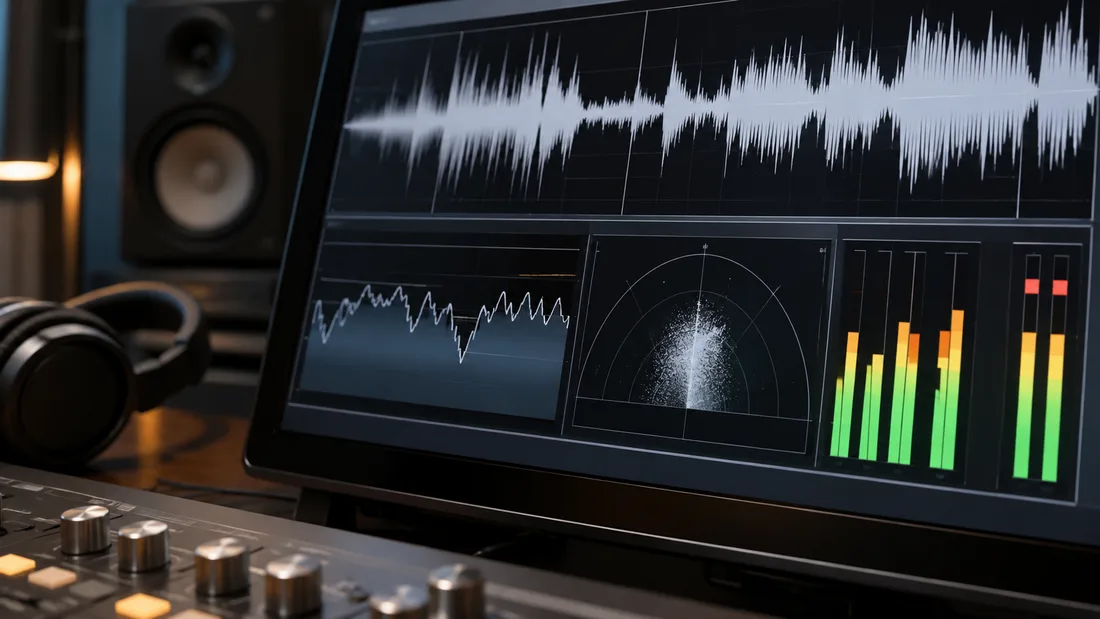
Two recordings with the same peak level can have very different subjective levels. A quiet piece of narration with one sharp consonant may peak at the same point as a heavily compressed voice that sounds consistently loud. Peak control remains useful for preventing overload, but podcast producers also benefit from measuring loudness over time. Integrated loudness, expressed in LUFS in many meters, uses frequency weighting and integration to provide a standardized account of the overall programme.
A common starting point is around negative sixteen LUFS for a stereo podcast and negative nineteen LUFS for a mono one, but these values are conventions, not compulsory settings for every distribution service. Requirements or recommendations can change and differ between systems. A mastering target should be chosen with the intended host and delivery arrangement in mind. A louder figure does not guarantee more intelligible speech if the recording has harsh consonants or a noisy room.
The integrated figure also has to be interpreted in the context of programme structure. A dramatic opening effect, a period of quiet speech and a loud closing soundtrack may yield a theoretically acceptable integrated value while presenting uncomfortable transitions. Listen to the relative balance of these sections. Short-term loudness measurements can reveal differences that are averaged away in a whole-programme reading. Use level automation or appropriate processing to achieve useful consistency without flattening every expressive detail.
True peak and encoding headroom
Sample-peak measurements show the values of individual digital samples. Upon reconstruction, the resulting continuous waveform can peak between those sample positions. A true-peak meter estimates these inter-sample peaks, normally by oversampling the signal. Lossy encoding can also change the decoded waveform and produce higher peaks than those measured in the source master. A master delivered extremely close to digital full scale may therefore create problems after conversion.
A conservative final ceiling, often around one or two decibels below full-scale true peak depending on the delivery specification, provides useful headroom. The exact limit is part of the mastering decisions and platform requirements. Do not use a limiter simply to make dense audio approach that ceiling throughout its duration. Check the effect of the limiter on speech consonants and transients. After making the intended compressed file, decode or play it back and check the resulting levels where practical.
Inspect the actual deliverable
Before uploading an episode, inspect the encoded file's duration, channel count and format. Play the file rather than trusting an export dialog. Pay attention to the initial second, transitions and ending. Check that metadata, if embedded, corresponds to the actual episode, especially when the export originated from a previous file's settings. Episode information supplied separately through a hosting service may take precedence over embedded tags in many clients.
Retain the exact master and published encoding together in the archive. This makes it easy to distinguish a problem that occurred during production from one that appeared during encoding, upload or playback. A podcast master is ready when its voices are intelligible, the changes in level feel purposeful and the delivered file works in the relevant listening environment. Meter readings and format choices support that outcome rather than defining it in isolation.