The loudest visible sample in a digital recording tells remarkably little about how loud the complete performance will seem. A sharply struck percussion instrument can create a high peak while contributing modest sustained energy. A dense arrangement of distorted guitars, bass and amplified vocals can sound considerably louder even if its sample peaks never reach that value. Audio production has several types of level measurement because they answer substantially different questions. Confusing those questions can lead to unnecessary limiting, unsuitable delivery files and comparisons made at inconsistent listening levels.
Digital peak measurements describe signal amplitude
A conventional sample-peak meter examines the magnitudes of values in the digital signal. In a fixed-point representation, zero decibels relative to full scale corresponds to the maximum nominal amplitude of that representation. Samples reaching the maximum do not alone establish audible clipping; the source and the behavior of the relevant processing stages determine whether distortion has occurred. Repeated flattened waveform sections can provide evidence of overload, but intentional synthesis and processing can create other waveforms with similar-looking features.
Many workstations use floating-point calculations internally, allowing some intermediate signals to exceed the conventional full-scale reference without being clipped at that particular stage. Other processors may respond differently, and a fixed-point export or physical output will have limits. Do not assume that every component of a session handles excessive levels identically. Maintain a practical margin through routing and listen for unintended distortion. Inspect the signal at the destination that matters rather than relying solely on a channel fader or a meter placed before subsequent processing.
True peak considers the reconstructed waveform
Discrete samples represent a signal that is reconstructed or otherwise converted during playback. The resulting continuous waveform can reach peak amplitudes greater than the individual sample values. A true-peak meter estimates those potential peaks through an appropriate oversampled representation. The measurement is expressed relative to the full-scale reference and is commonly displayed in dBTP. It gives information about peak behavior that sample-peak metering alone does not provide.
Processing and conversion can also alter peak levels. Changing sample rate, filtering or encoding into a lossy format can produce a decoded signal with a somewhat different waveform. Consequently, maintaining a margin below the relevant peak ceiling is prudent when preparing material for additional processing. The exact required limit depends on delivery specifications and the intended application. A music release, a broadcast file and a production asset awaiting further processing need not use the same ceiling. Check the rendered or appropriately converted result when the destination specifies particular constraints.
Averaged energy is a different property
An RMS measurement relates to the square root of the mean of squared signal values over a given interval. It provides an indication of signal energy over time rather than examination of only the largest instantaneous value. A sustained tone with moderate peaks can have appreciable RMS level, while a recording with occasional short transients can have lower average energy even when its peaks are high. Meter behavior depends in part on the chosen integration interval and calibration conventions.
Neither peak nor simple RMS measurement takes fully into account how human perception responds to different frequencies and temporal patterns. A strong low-frequency tone and a sustained midrange sound with similar RMS levels need not be perceived as equally loud. Spectral balance, listening level and the individual listener all influence the result. This is one reason why a mix can show substantial meter activity while its lead melody remains difficult to distinguish. Relative audibility also depends on competing sounds rather than on the isolated track's absolute measured level.
Loudness measurement involves standardized weighting and integration
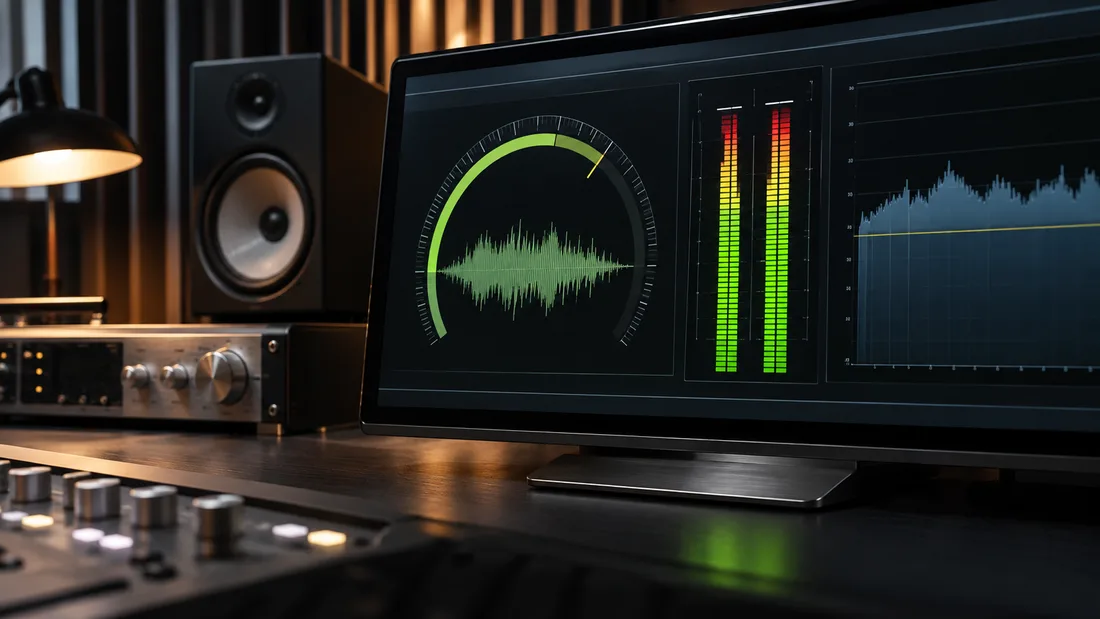
Modern program-loudness measurements frequently use methods associated with the ITU-R BS.1770 family of recommendations. These incorporate frequency weighting and channel-related calculations to establish a useful measure of program level. Implementations designed for relevant broadcast or production recommendations may also include gating and defined integration procedures. Integrated loudness over a complete program is generally expressed in LUFS or LKFS according to the adopted conventions. The numerical result describes a particular measured property, not a prediction of every listener's exact subjective experience.
Momentary and short-term displays show how measured loudness develops over different, relatively local intervals. They can be useful when comparing verses and choruses, identifying unusually loud dialogue passages or observing how a compressor influences a sequence of phrases. Integrated loudness covers a much longer measurement period, such as an entire track. Reset the relevant measurement and play the complete intended program when verifying an integrated result. Measuring only the loudest section and treating it as the track's integrated loudness will produce misleading information.
Dynamic contrast is not captured by a single number
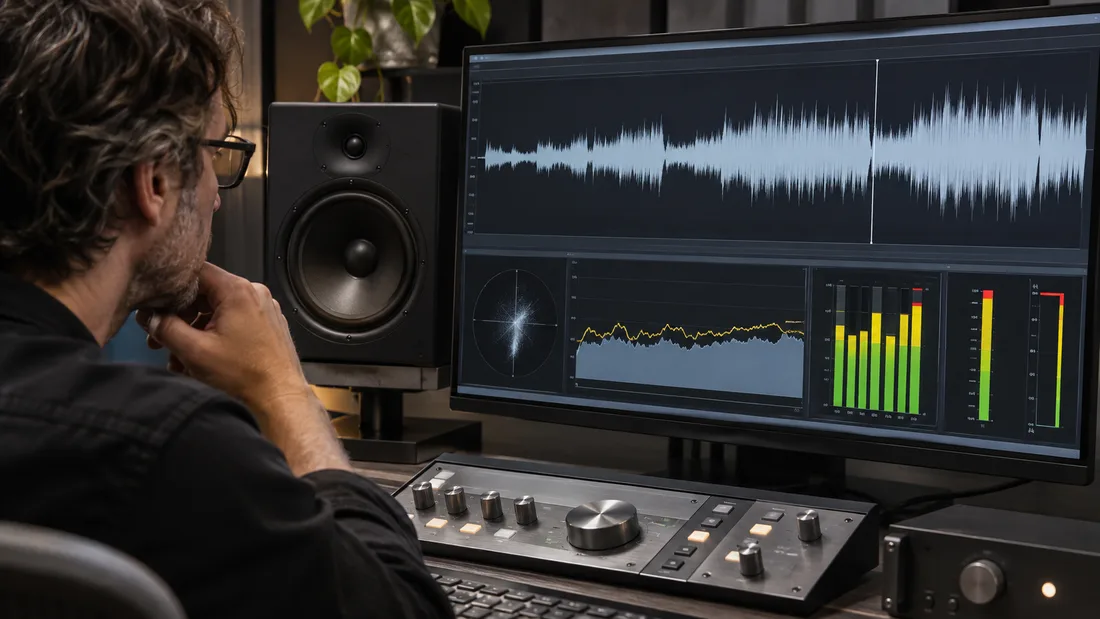
Two recordings with the same integrated loudness can differ markedly in their internal dynamics. One might begin quietly, build gradually and finish with a large orchestral climax. Another might maintain a relatively constant level throughout. Their measured integrated values may be comparable, but their musical movement and momentary presentation are entirely different. Peak-to-average relationships and loudness-range measures can supply additional information about certain aspects of dynamics, provided their definitions and measurement conditions are understood.
Listen to the actual transitions that create these differences. If a heavily compressed recording already has the desired intensity, increased limitation may offer little benefit beyond raising a number. On a sparse acoustic arrangement, controlling occasional distracting peaks can allow a more comfortable overall listening level without destroying the natural differences between notes. The most appropriate amount of modification follows from the performance and its intended use. Do not force dramatic material to match a statistic derived from an unrelated musical genre.
Normalization changes playback gain, not the stored performance
Many playback systems can adjust program gain according to a loudness measurement and a selected playback reference. Their precise behavior varies with the service, settings, device, format and current implementation. Some distinguish individual-track and album-based behavior. Gain changes may also be constrained according to peak levels or other service-specific decisions. A producer cannot reliably infer that every listener will hear an identical normalized level, particularly because absolute listening volume remains under user control.
Practical comparison therefore begins with matching playback level closely enough to judge the underlying sound. Select the same portion of the original mix and a processed version. Adjust their audition gain independently while leaving the actual source files intact. If the processed version still has stronger rhythmic definition, well-controlled bass or a more suitable tonal balance, the modification is achieving something beyond level. If its apparent superiority disappears when playback gain is compensated, reconsider whether the additional processing was justified.
Use measurements differently at different production stages
During recording, a peak indication helps establish whether sufficient margin remains for stronger transients. It is usually unnecessary to pursue a finalized program-loudness number at that stage. During mixing, meters help diagnose unexpectedly high bus levels, track differences and the cumulative contribution of effects. Relative listening is particularly important because the relationship between parts determines whether the recording remains intelligible. During mastering or technical compliance preparation, measurement of peak behavior and program loudness becomes more directly relevant to the delivered file.
Speech and music also present different practical questions. A podcast or instructional recording usually benefits from a level relationship that allows listeners to understand ordinary speech without constantly adjusting volume. A musical release can make large dynamic changes an intentional part of its aesthetic. When spoken narration, background music and sound effects coexist, examine important speech passages individually alongside the complete program measurement. A suitable overall number does not guarantee that every essential sentence is intelligible.
Build a delivery check around actual requirements
Confirm the receiver's current specifications before rendering a final deliverable. Record the intended sample rate, channel arrangement, format, word length, permissible peaks and any applicable loudness measurement. Make your chosen meter settings consistent with those requirements where possible. Render the final file and measure that actual file from beginning to end. A correctly configured session does not necessarily prove that its export has the intended channel layout or that conversion produced exactly the expected peak values.
If a file fails a required measurement, determine which property caused the failure. A small excess in the output ceiling may need a comparatively minor adjustment, while excessive integrated loudness might call for lowering gain. A large mismatch in local speech levels may warrant revisiting editing or dynamics processing. Correct the actual issue and listen again after rendering. The best final checks combine several independent kinds of evidence: the sound of the complete program, measured compliance where appropriate and confirmation of its file properties. Meters make those decisions more reliable precisely when their different meanings remain clear.