The sense of space in a recording emerges from differences between two audio channels. A voice with nearly identical signals in the left and right channels can appear to come from a phantom center, while a single recording directed predominantly toward the left acquires a different apparent position. More complicated relationships supply both a sense of location and a sense of width. Stereo processing can change any of those qualities, but the listener's eventual playback arrangement determines how successfully the resulting image is conveyed.
The phantom center is not a separate loudspeaker
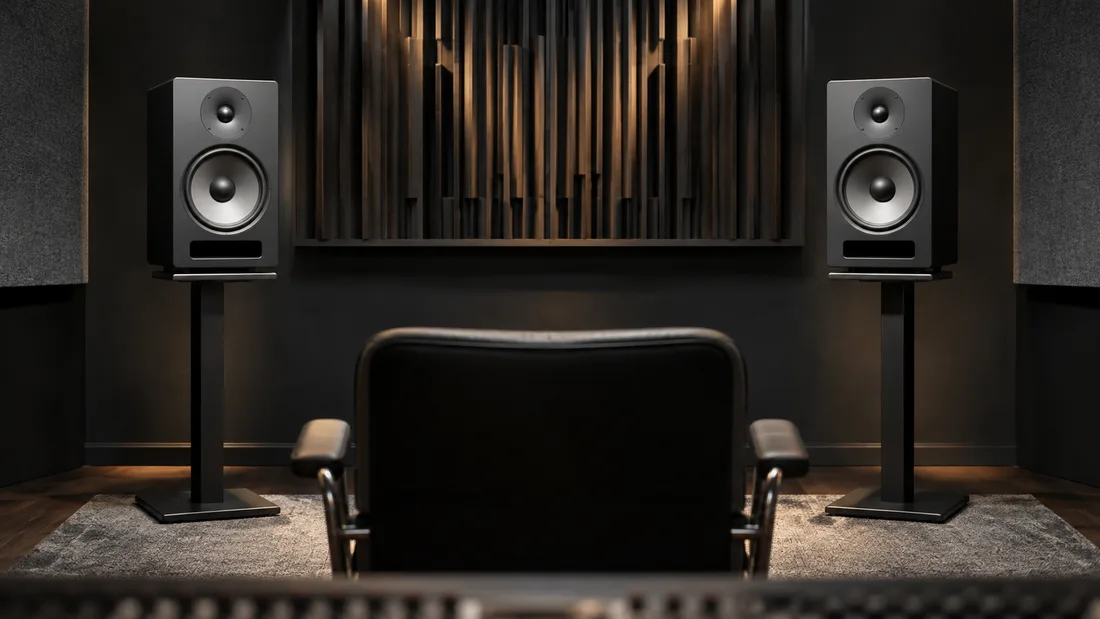
In conventional stereo playback, a signal reproduced by both speakers at the same relative level and timing often appears between them under suitable listening conditions. Move toward one speaker and the differences in arrival time and level can shift the apparent position. The room's reflections also contribute to what reaches the ears. On ordinary headphones, the channels arrive more independently and the apparent image may develop within or around the listener's head rather than at the positions suggested by speakers.
This difference helps explain why panning choices made on headphones deserve checking with speakers. A sound panned entirely to one side on headphones may feel conspicuously disconnected, whereas loudspeaker playback provides acoustic contribution to both ears. Conversely, complicated width effects may appear dramatic on headphones but unstable at different listening positions in a room. Give particularly important elements a recognizable role regardless of the system. The lead vocal of a conventional song can retain a stable center while background instruments establish the sides of the field.
Choose a useful distinction between position and size
Moving a mono track through a stereo pan control primarily changes the balance sent to left and right. A stereo recording, however, can already contain considerable width. Many workstation controls marked as pan on stereo tracks function as balance controls or offer different stereo placement modes. Attenuating one channel of a stereo piano is not necessarily equivalent to shifting the entire piano toward the corresponding side. Determine how the software handles channels rather than judging the operation by its label.
A wide instrument can compete with a second wide instrument across the entire field. Rather than placing both at maximum width, ask which one should define the spatial extent of the arrangement. A reasonably narrow rhythm guitar might occupy one region while a keyboard extends softly across more of the recording. Even a stereo microphone recording can sometimes benefit from a reduction in width when it is placed alongside many other parts. A smaller image can be musically useful if the surrounding space gives it a recognizable shape.
Investigate polarity and timing before widening
Several microphones recording the same event will often contain related signals with different arrival times, spectral balances and reflection patterns. The differences can be an important component of their stereo impression. Combining partially related signals also produces interference, which can alter level and frequency balance when channels are summed. Flipping the polarity of one signal reverses its waveform. It is not equivalent to correcting a time delay across all frequencies, even though the change can sometimes improve a combined recording.
Listen to microphone groups in the stereo arrangement for which they are intended and then sum them to mono. If a principal sound becomes unusually thin, compare the corresponding individual paths. For a multi-miked drum kit, the overhead and close microphones may interact in a frequency-dependent way. Adjusting one path's timing or polarity might change the combined snare or kick. Avoid treating every visible offset as an error. Differences in arrival from actual microphone spacing may establish the natural depth and width you wanted to capture.
Understand what mid-side processing changes
A conventional mid-side representation derives a mid signal from the combination of left and right and a side signal from their difference, with scaling determined by the implementation. Returning to ordinary stereo reconstructs the left and right channels from combinations of the two. A completely identical signal in both channels has no difference component. Increasing the side contribution can therefore increase the prominence of left-right differences relative to shared signal information. Decreasing it can narrow a stereo recording.
The side channel is not simply a collection of sounds physically located at the extreme sides. It can contain differences produced by reflections, microphone spacing, stereo effects and channel-specific timing. Equalizing it may therefore alter several aspects of the perceived stereo image at once. If you increase side energy around high frequencies to brighten an ambience, listen to the balance of percussion and sibilance as well. A wide high-frequency response may sound spacious on one system but distracting on another. Changes to the mid signal affect the shared information and can alter the perceived center relative to surrounding material.
Check presets that rely on delay and phase manipulation
Some widening processors construct differences between the channels using short delays, phase-related processing or frequency-dependent manipulations. The effect may be immediately apparent, particularly on an originally narrow source. When related signals of different timing are summed, frequency-dependent cancellations become possible. A sound that seems pleasantly broadened in stereo may lose a recognizable part of its tone in mono. Another effect may produce a disproportionately weak phantom center when the listener is not positioned symmetrically.
Test any such processor using its original dry signal as a reference. Match approximate level, assess the stereo placement, then monitor the mono sum at a corresponding gain. Listen for important aspects of the sound that disappear rather than expecting an exact tonal match under both conditions. A wide acoustic recording naturally changes when summed; the issue is whether the change harms a musical anchor. If the processor is especially destructive, reduce its strength or use a less intrusive method of creating separation. Independently performed doubles often provide richer differences without the systematic interference pattern of a copied delay.
Use stereo measurements to support your hearing
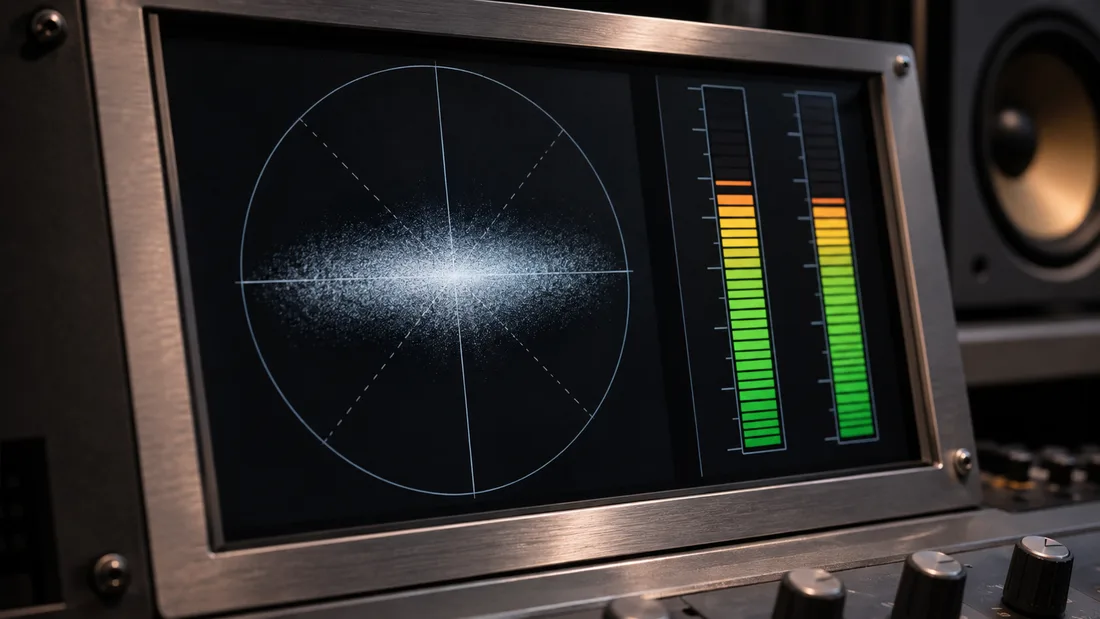
A correlation indication describes a particular statistical relationship between channel signals over a measurement interval. Positive values suggest a degree of similarity, while strong negative correlation can indicate opposing relationships that deserve attention. The meter cannot decide whether a recording sounds good. A widely dispersed ambience may exhibit little correlation without causing a severe practical problem. A brief moment of negative correlation might have little musical consequence. Persistent strongly negative readings on a central or essential source are more concerning.
Vectorscopes and related stereo displays offer other views of the channel relationship. Their patterns can help identify a nearly mono signal, unusually broad material or a visual imbalance. Different designs orient the display differently, so familiarize yourself with a known mono recording and a known polarity-inverted example at safe monitoring levels. Once the display's behavior is familiar, use it to investigate suspicious passages instead of trying to produce a particular graphical shape for every song. The musical content, not a geometric pattern, should determine the final decision.
Protect important low-frequency relationships
Stereo bass is not inherently unsuitable, but low-frequency content occupies considerable energy and influences perception of the whole foundation. Some playback situations combine channels or redirect substantial low-frequency content to a shared speaker system. The way this is implemented varies. When left and right bass information contains substantial opposing components, a combined version may lose weight. Examine the effect of summing on kick drums, bass synthesizers and recordings of large instruments rather than assuming stereo bass automatically needs correction.
High-pass filtering a difference signal is one possible way of reducing stereo differences in selected low-frequency regions, but it is still a change to the original mix. A simpler approach may involve narrowing the particular source that causes the problem, adjusting its effects or choosing a better-recorded layer. Check how these interventions affect any intended room character or musical movement. A centered foundation and spacious upper-frequency textures work well in many productions, yet some arrangements legitimately benefit from substantially different spatial choices.
Evaluate the mix from several positions
Near the center of a familiar speaker setup, listen for the stability of important sounds and the shape of the surrounding field. Shift your listening position a little to each side. Use headphones to inspect details that the room may obscure. Finally, listen to the summed signal, ideally through a single speaker for a direct comparison of relative levels without two-speaker acoustic interaction. A stable mix need not create the same illusion of space in all three conditions. Its important melody, rhythm and tonal relationships should nevertheless remain recognizable. The most convincing stereo image is often one whose width has a musical purpose rather than a measurement target.