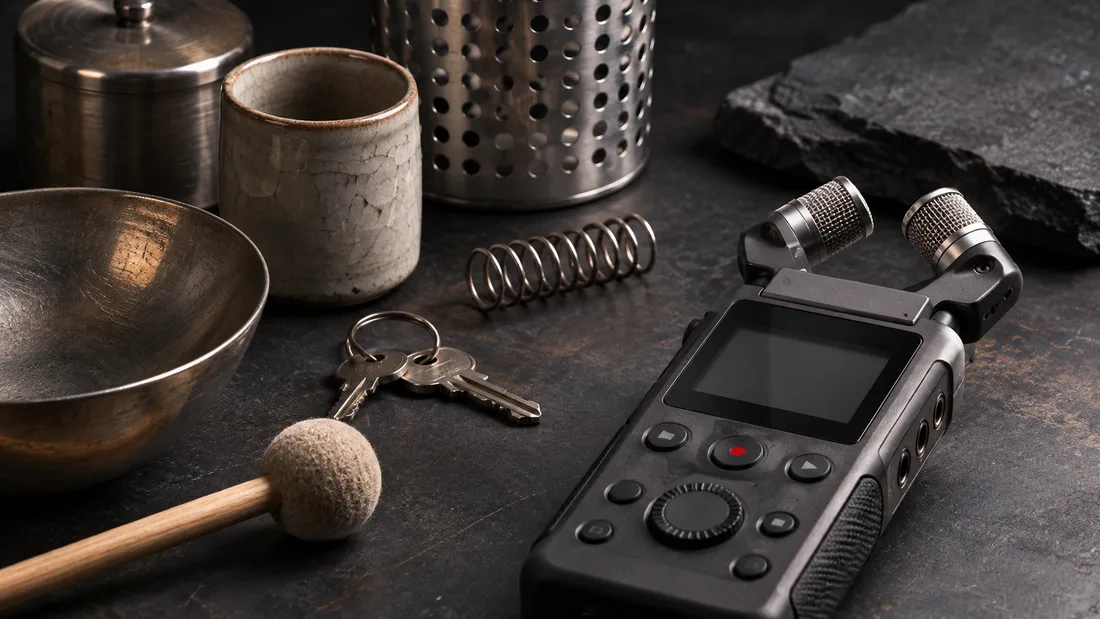
Some of the most expressive material in a sound designer's library begins as an ordinary physical event. A lid is moved across a ceramic vessel, a wooden object falls onto a cloth-covered bench, or air vibrates through a loosely attached panel. Recorded from a carefully chosen distance, those events can contain complex textures that are difficult to reproduce with simple synthesis. The opportunity lies in deciding which characteristics of a real sound to retain and which to transform. The designer can produce a convincing representation of an object or create something entirely unrelated to its visible origin.
Collect source material with an intended purpose
A large number of unexamined recordings can be less useful than a small collection whose properties are understood. When capturing material for a production, begin by identifying the qualities the final sound requires. A heavy fictional mechanism may need a sharp onset, resonant low-midrange body and decaying details that suggest motion. A soft environmental transition could require something with continuous texture and relatively few distinct transients. Try recording objects that contain one or more of those properties rather than expecting every source to supply the finished sound.
Record several variations of important events. Change force, speed, the contact surface and the position of the recording device. A sheet of metal may respond very differently when tapped near a supported edge and when struck at a freely vibrating point. Fabric can absorb some frequencies while allowing movement to remain audible. Maintaining consistent recording levels and noting significant changes makes it possible to compare these variations without relying on memory. Handle fragile or noisy objects sensibly, and avoid recording situations that require unnecessarily dangerous physical actions.
Perspective gives the material a recognizable scale
A microphone placed very close to an object can capture mechanical detail that would be less prominent at ordinary listening distances. Tiny surface movements, friction and air displacement might become substantial components of the recording. At a greater distance, the room or outdoor environment contributes more strongly relative to the direct event. Those perspectives are not interchangeable. The close recording may be especially useful for designing an enlarged fictional object, while a more distant recording can supply reflections that make the sound belong to a recognizable space.
Make separate recordings of these perspectives when circumstances permit. If multiple microphones record the same event simultaneously, preserve their timing relationships and inspect them together before mixing the signals. Wind, handling and unwanted floor vibration may cause substantial low-frequency contamination when using a portable recorder. Choose stable support, protection suited to the conditions and adequate recording margin so unexpected transients do not overload the input. Good source files permit a wide range of later changes; processing a badly compromised recording usually offers fewer convincing options.
Describe recordings through their sonic features
After a session, listen to the captured examples and label useful sounds by both source and quality. A file named for the actual object remains easy to interpret, but a description such as brittle rattle, long metallic decay or irregular scrape helps retrieve it for unrelated projects. Include microphone perspective, recording date and take number where these are relevant. A later project may require quiet movements rather than the more dramatic versions that received attention during the original session.
Retain unprocessed, adequately documented recordings separately from rendered designs. A heavily filtered low-pitched version of a sound may be useful in one scene but unsuitable for a new idea. Returning to the original lets the designer make fresh choices about timing, pitch and processing order. Trim or mark regions of interest while preserving reasonable handles around their boundaries. The preceding buildup and following decay are often valuable in their own right, even if the immediate recording objective was a single impact.
Construct a layered event around its temporal shape
Most convincing constructed impacts have parts that perform different functions. A sharply defined onset establishes the moment of contact. A more sustained resonant component communicates size or material. A sequence of smaller movements suggests objects vibrating, sliding or separating after the main event. Recordings that are unimpressive by themselves can be extremely useful in one of those roles. Align layers according to their audible contributions, not simply their largest waveform peaks. A preparatory movement might need to begin before the principal impact.
For a fictional door mechanism, for instance, a short wooden knock might define the contact point, an enclosed metal resonance provide weight, and a quieter irregular click suggest a latch. You need not make each recording large and dramatic. Heavy low-frequency layers can overlap in a way that obscures their individual onset, while several bright transients can produce an indistinct noisy edge. Reduce the competing regions or alter relative level until each layer supports the intended event. Listen to the composite as a whole and mute individual layers to find out whether they add useful information.
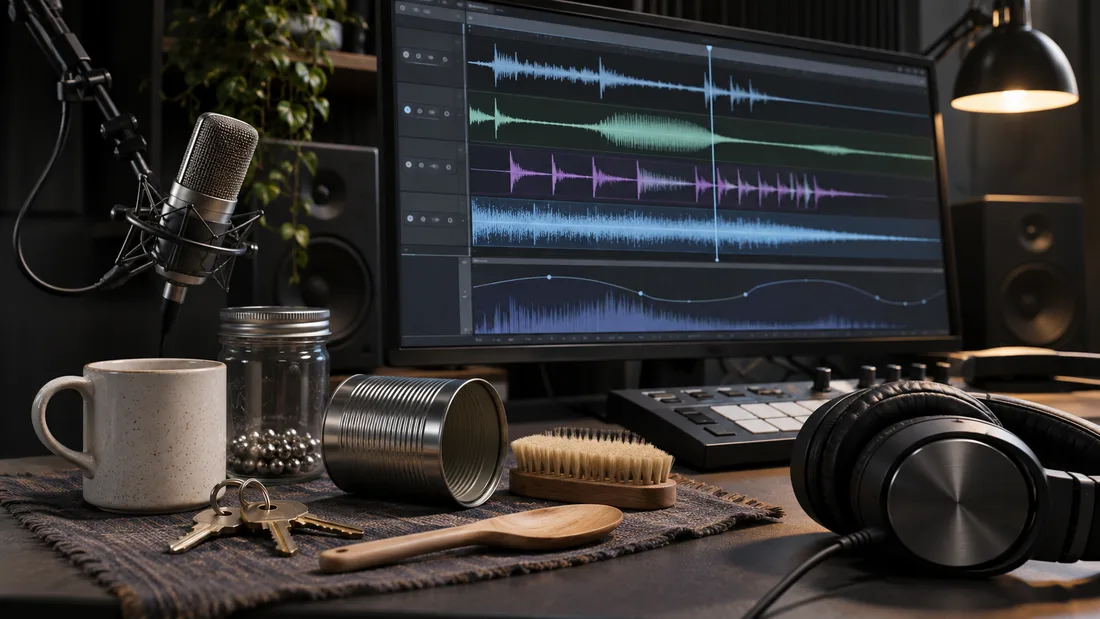
Use pitch changes to alter the perceived source
Playing a recording more slowly without compensating for duration reduces its frequencies and lengthens the event. Details that were initially too brief to distinguish become audible, and relatively small objects can suggest substantially greater size. Depending on the destination format, extreme shifts may leave limited upper-frequency information. A higher-pitched companion recording or a carefully selected layer can restore definition if the resulting texture is otherwise too dark. On the other hand, a dark result may be exactly what a production requires.
Some processing systems alter pitch and duration independently through specific signal-processing algorithms. Such techniques can be useful for fitting the same basic event to several picture cues, but they may introduce changes to transients, internal timing or texture. Those artifacts can either undermine a believable effect or become part of a deliberately unfamiliar design. Render promising versions from the best available source files. A pitch-shifted version that already contains desirable artifacts can be considered a new creative source, yet it is still worth preserving its unaltered predecessor for later comparison.
Filtering and resonance can suggest a larger environment
Equalization directs attention to different components of a physical recording. Removing strong low-frequency noise from a close scrape can reveal its delicate rhythmic irregularities. Isolating a useful resonant region can transform an impact into a tonal event with a recognizable pitch. A moving filter may suggest gradual changes in the size, speed or enclosing material of an imagined object. Such movements are often more expressive when their timing relates to the rhythm of the original performance rather than an arbitrary repeating modulation.
Reverberation then helps establish where the sound belongs. A dry action may be combined with separately recorded ambience or a suitable artificial space. If a designed effect has several distinct perspectives layered together, decide how much apparent distance each should communicate. A very close transient combined with a distant resonant tail can imply a large surrounding space. Excessive reverb on several layers independently may blur the composite and obscure small timing details that made it expressive. A shared effect or a modest ambience layer can be easier to control.
Make variation part of the design
Repeated triggering of an identical recording is sometimes conspicuous, particularly when natural movement is depicted over several seconds. Create several related versions from independent takes and give each a similar functional role while retaining small differences in articulation. Ensure that their relative levels remain compatible with how they are intended to be used. In interactive audio, slight timing or pitch variations may be useful when they do not alter the identity of the event. A designed mechanism that belongs to the same object should still sound recognizably consistent from one use to the next.
For a linear production, changes can be selected specifically in response to the picture, narrative or music. Listen to the sequence rather than the isolated sound effects. The most noticeable event may deserve fewer surrounding details so that its shape remains clear. Several subtle motions can contribute to a convincing environment without drawing attention to each recording individually. Keep the design aligned with the scene's perspective and rhythm. Even a highly unusual sound becomes credible when its onset, movement and decay have a logical relationship to the event the listener perceives.
Deliver reusable material as well as the final sound
Keep a version of the assembled effect with its layers accessible. Render the complete sound at the agreed technical format and preserve enough pre-roll and decay for its intended use. Where useful, also supply individual functional layers or alternate versions so the final mixer can adjust emphasis without reconstructing the entire design. Proper naming distinguishes raw material, experimental transformations and approved delivery assets. This modest discipline allows one productive recording session to support many later ideas. The resulting library becomes a collection of understandable sonic resources rather than an accumulation of anonymous files.