A close microphone often produces a strikingly detailed recording with remarkably little sense of place. The breath of the singer, the movement of fingers and the attack of each note may be clearly audible, but they appear to emerge from an unnaturally empty world. Reverberation can place that recording within a convincing acoustic setting. It can also deliberately invent a space that no architectural room could provide. Deciding which of those goals matters is the first useful choice when introducing a reverb to a mix.
How direct sound and reflections describe a room
In a real space, sound reaches a listener by several paths. Direct sound travels from the source to the listening position. Other energy arrives after reflecting from floors, walls, ceilings and objects. A few distinguishable early reflections are followed by increasingly dense arrivals that form the perceived reverberant field. The amount of direct sound relative to reflected energy conveys useful information about distance and environment. Absorption, diffusion, room geometry and the positions of both source and listener influence the result.
Artificial reverberation permits those elements to be manipulated independently to a degree that physical acoustics generally cannot offer. Some processors allow the early reflections to be adjusted separately from the later tail. Increase the early component and you may perceive greater enclosure without a large increase in sustained wash. A strong tail with relatively weak early reflections can feel soft and detached from the sound that generates it. Such distinctions explain why processors with apparently similar decay lengths can produce strikingly different impressions.
Choose a useful decay in the actual arrangement
Reverb time is often described through the decay of acoustic energy. The familiar room-acoustics measurement RT60 relates to the time taken for sound level to decay by sixty decibels under suitable conditions. A software reverb may use a more complex internal definition or display a simplified nominal decay. Regardless of the parameter label, the duration of audible energy depends upon frequency, diffusion and the original signal itself.
Try setting the decay by listening to the gaps in a performance. A long ending to a chorus might support a spacious ambience, whereas rapidly repeated syllables can be considerably harder to understand when each tail overlaps the next. A quiet acoustic song has space for audible reverberant detail that a dense percussion arrangement might not tolerate. Instead of trying to derive decay from a beat division alone, judge where a previous note's ambience becomes intrusive. The rest of the arrangement supplies a practical measure of acceptable overlap.
Pre-delay preserves the connection to the source
Pre-delay inserts time between the direct signal and some or all of the reverb response. Depending on the processor, the placement of early reflections may have separate controls. Introducing a short delay can help a foreground vocal, for example, retain its clear initial consonants before the reverberation becomes prominent. Longer pre-delay can create an obvious separation between the original sound and its surroundings, sometimes suggesting an implausibly distant reflection or a deliberate production effect.
Set pre-delay while the entire mix plays. Increase it until the beginning of the sound becomes easier to distinguish, then check the space in between words. A detached echo after each phrase may be more distracting than the original diffuse tail. The optimum setting can change between a busy verse and a quiet bridge; a little automation or a second ambience can accommodate the transition. There is no architectural need to force every instrument through an identical pre-delay if the goal is clarity in a constructed musical space.
Darken the returning sound where appropriate
Actual surfaces do not reflect every frequency equally. Upholstery and thick curtains absorb appreciable high-frequency energy while having comparatively limited influence at much lower frequencies. Materials, geometry and the room's contents give its decay a characteristic spectral balance. Artificial reverbs frequently include damping controls that determine how rapidly different frequency regions decay. These may sound different from applying an ordinary equalizer after the effect, which changes the whole response according to a fixed curve.
A bright reverberant return can draw close attention to breath, cymbal spill, pick attack or sibilant consonants. A darker return may offer space without competing so directly with the foreground sound. On a vocal send, it can be worth reducing high-frequency energy before the reverb, particularly if sharp consonants excite the tail. A gentle low-frequency reduction on the return can prevent several instruments from creating a thick, indistinct layer near the bass foundation. Set these filters by listening rather than enforcing an identical cutoff throughout the mix.
Convolution and algorithmic reverberation
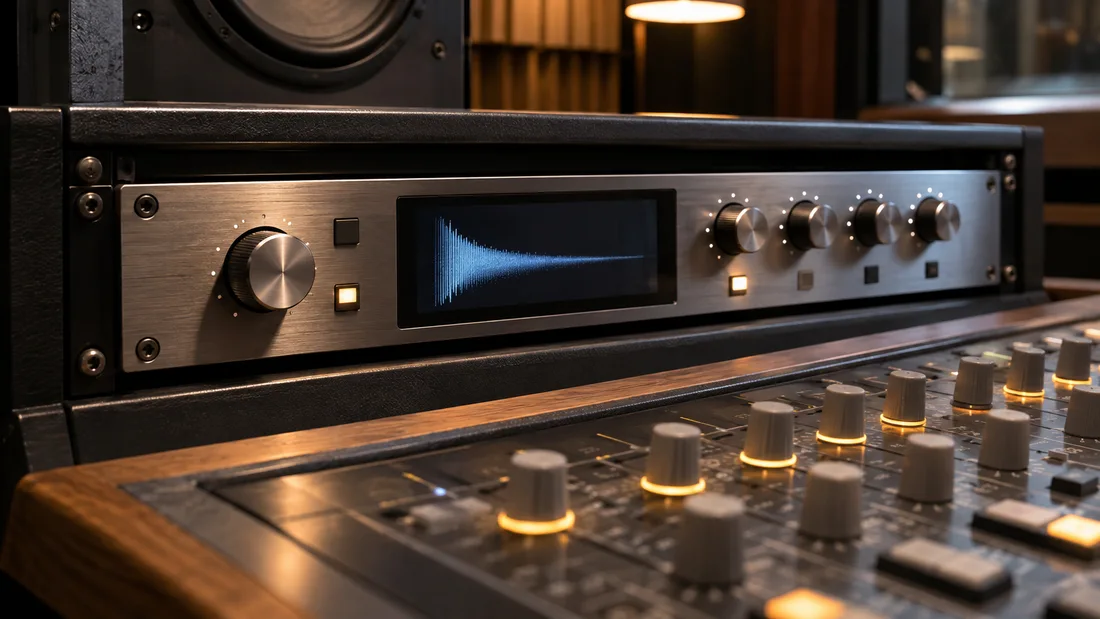
Convolution systems use an impulse response to reproduce the measured linear response of a system or acoustic path. High-quality measurements of a room, plate or other device can provide a detailed and distinctive sense of space. The recording method and placement determine the captured perspective. A measurement of one position in a hall cannot represent every location within it, and an impulse response will not automatically reconstruct changing conditions or nonlinear behavior.
Algorithmic reverberation uses networks of delays, filtering, feedback and other techniques to form the effect. These designs need not emulate a particular building; some vary the decay structures or introduce modulation to create smooth or evolving tails. Plate simulations may produce the dense resonant character associated with physical reverberation plates, while spring simulations may emphasize the dispersive metallic quality familiar from instrument amplifiers. Choose an impulse response if a convincing fixed location is central to the project; consider an adjustable algorithm when the effect must change with the performance.
Use reverb sends to organize a mix around depth
One useful workflow is to start with a few auxiliary spaces rather than insert a separate reverb on every recording. A short room might unify close percussion and instruments recorded under different conditions. A longer, more diffuse reverb could serve a lead melody and selected harmonies. An additional distinctive effect may belong on an occasional phrase. Sharing effects can make separately recorded elements feel related and gives each space a convenient master level.
Evaluate the stereo image of each return. The physical space implied by a central source and wide ambience is not necessarily the same as that suggested by equally wide direct and reverberant signals. In a dense mix, a narrower ambience may be easier to accommodate. Stereo effects can also behave unexpectedly when a recording is played in mono, especially when they use phase-related widening. Check the sum before making decisions based entirely on headphone width. A central voice should remain sufficiently distinct from its surroundings when played on a single speaker.
Treat reverb as a moving performance element
Automating a send can preserve clarity during a complicated line while highlighting an exposed phrase at its end. On a lead vocal, for example, make the room modest enough that the words remain intelligible, then allow more signal into a long reverb at a deliberate moment. The effect continues to decay after the send decreases. This often sounds more natural than muting the return immediately, which removes already existing reverberation. If a dramatic cutoff is part of the composition, however, automation of the return itself is entirely appropriate.
Sidechain compression can also adjust the relationship between a direct sound and its ambience. A compressor on a reverberant return can reduce the return during a prominent voice and recover in the spaces around it, provided the routing allows the original voice to control the detector. Set the release according to the phrase, avoiding unnecessary rhythmic surges. This is a useful alternative when manually adjusting every word would be time-consuming, but test whether the movement genuinely improves the presentation.
Learn to hear the return in silence
At several points during mixing, stop the transport after a significant passage, allowing the ambience to decay naturally when the software permits it. Notice whether a supposedly short effect is actually lingering across a long gap, whether a low instrument leaves an unexpected resonant tone and whether every space has acquired a similar bright edge. Then mute all reverbs together. If the mix immediately becomes unnatural and crowded rather than simply drier, the spatial construction is likely contributing something worthwhile. Restore one return at a time and simplify any that do not make a meaningful contribution. Reverb is most persuasive when its amount, frequency distribution and temporal behavior help describe the musical world rather than merely announce the presence of a processor.